 Free Delivery in Batumi


Blog
From the workshop: materials, care, gifts and the stories behind the pieces.
-
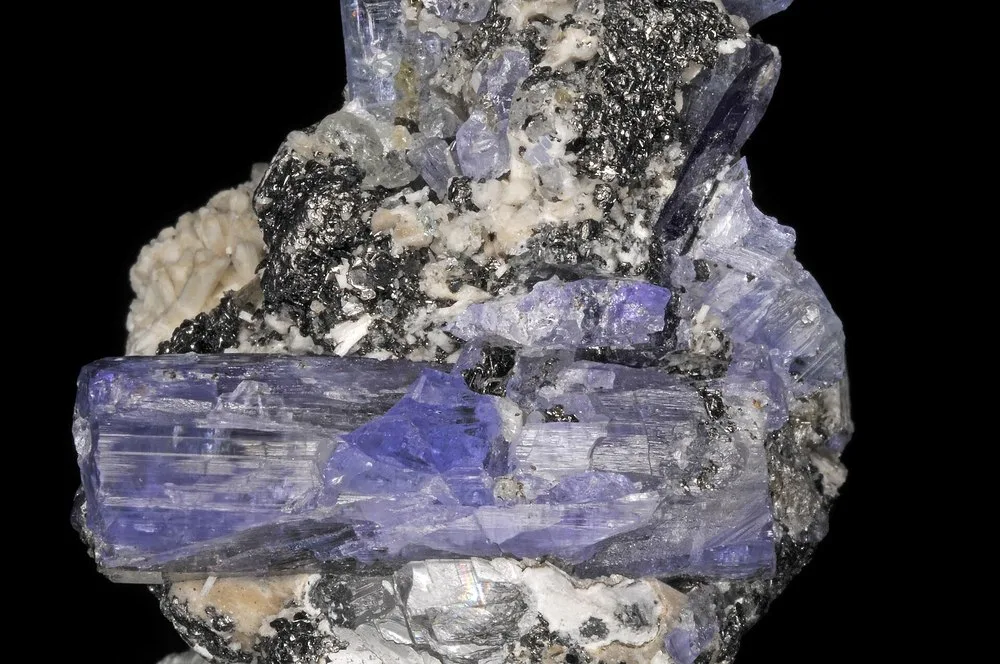
Tanzanite
Chemical formula – Ca₂Al₃(SiO₄)₃(OH)
Hardness – 6.5–7
Colour – blue, violet, pleochroicTanzanite is a member of the zoisite group. It was discovered in 1967 in northern Tanzania, near Arusha, and named after the country — though an American jewellery house did much of the work in making it famous, turning the stone into a symbol of elegance.
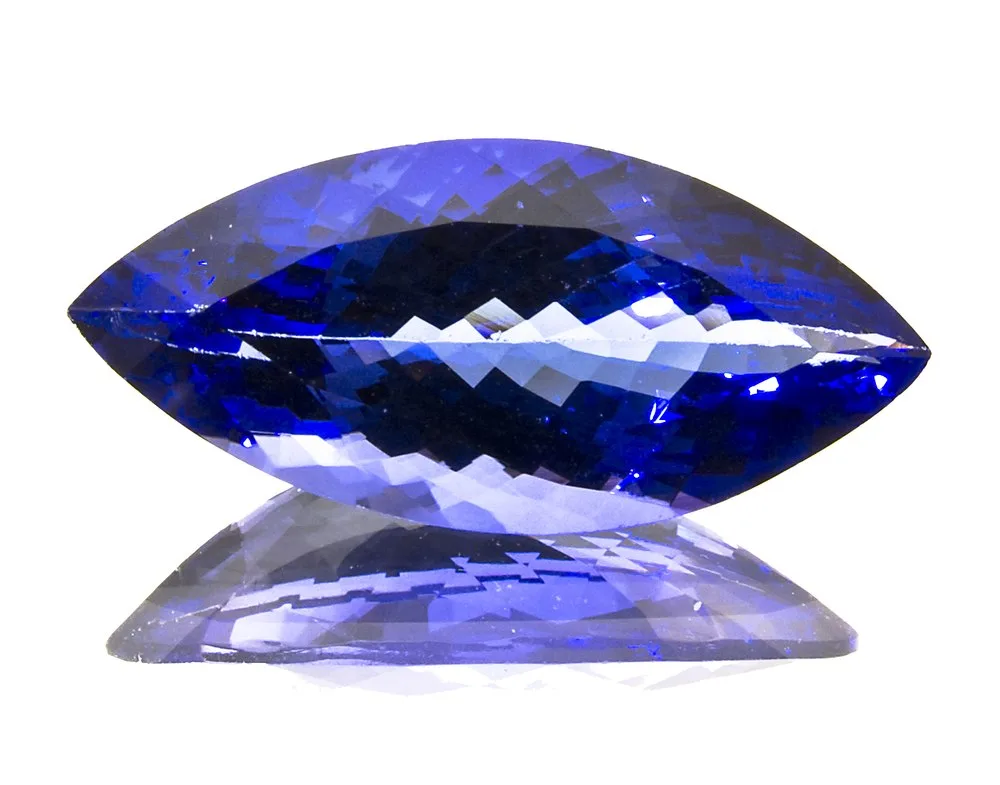
Tanzanite is trichroic: the same stone looks blue, violet or reddish-brown depending on the angle. That is why a cutter orients the top of the stone so the viewer sees the cleanest possible blue.
Today tanzanite is mined in exactly one place on Earth — the Mererani hills in Tanzania. The supply is finite, which keeps the stone expensive and pushes its price up year after year.
Origins
Tanzanite can only be mined in one location: northern Tanzania, in the Mererani hills near the city of Arusha.
Properties
Tanzanite is often called the stone of magic. Esoteric writers treat it as a stone of spirituality above all: it strengthens intuition and the sixth sense.
It suits workaholics especially — tanzanite is said to calm them and to help them rest. Tradition holds that the stone brings its owner success, particularly in creative work.
Traditional healing properties
Lithotherapists consider tanzanite helpful for eye conditions and for improving eyesight. It is also used to calm the mind and to sleep better. The stone is said to release stress, tiredness and pain.
This describes traditional practice, not medical advice. A stone does not replace a doctor.
Chakras
The sixth chakra – ajna.
Zodiac
Tanzanite is said to suit the water signs — Pisces, Scorpio and Cancer. One interesting exception is Aries, which tradition also pairs with the stone.
In Charcho jewellery
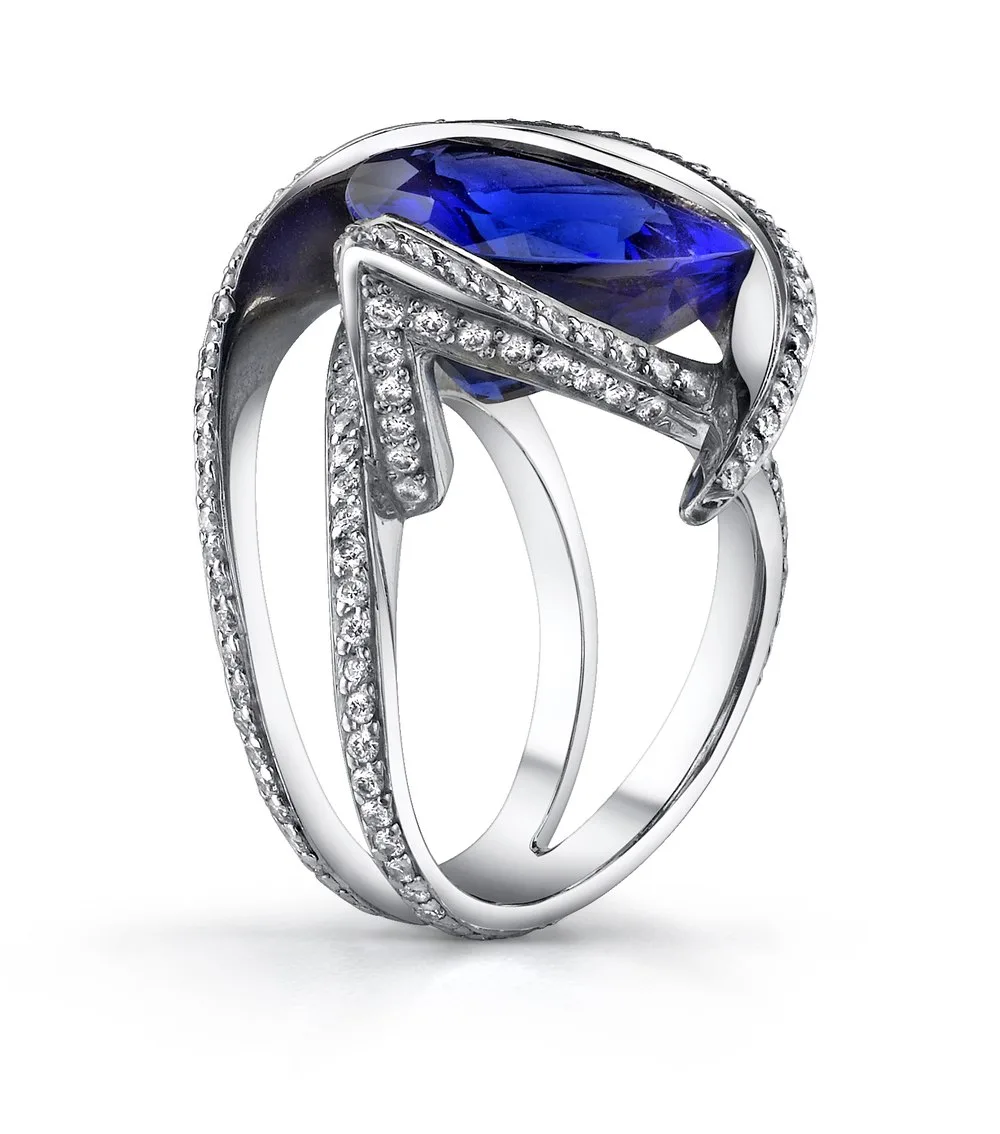
We usually cut tanzanite as a faceted stone so the colour shows fully. Hardness 6.5–7 is enough for jewellery, but the stone has distinct cleavage and will not take a knock — so in rings we choose a high, protective setting. We have no ready-made piece in the catalogue yet, but we make them to order. Catalogue: rings.
Real or fake
- Most tanzanite on the market is heated — standard, legal practice rather than a fake: heating turns the brownish tone blue.
- Fake tanzanite is often glass, showing air bubbles and a colour that is too clean.
- Dyed zoisite is cheap, but the pigment collects in cracks and fades in light.
- A real stone changes shade from different angles; an even, unchanging violet should make you suspicious.
Care
Tanzanite needs no ultrasonic or steam cleaning — warm water, mild soap and a soft cloth are enough. Avoid hot water, acids and long sun exposure. Take a ring off for manual work: cleavage makes the stone prone to cracking from a sudden blow.
See also
-
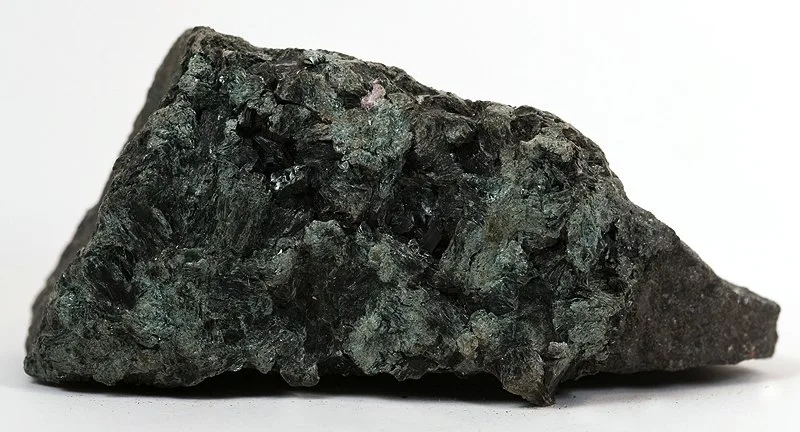
Seraphinite
Chemical formula – (Mg,Fe²⁺)₅Al₂(Si₃Al)O₁₀(OH)₈
Hardness – 2–2.5
Colour – green, grey-green with a silvery patternSeraphinite belongs to the chlorite group — more precisely, it is a variety of clinochlore. Its signature is the pattern across the surface: fine silvery or white lines cross one another until the stone looks like a feather or a fragment of a wing. The effect comes from a fibrous structure rather than from inclusions, so the drawing continues deep into the stone.
The name goes back to the Hebrew "seraphim", the highest rank of the celestial hierarchy, described in tradition as six-winged. The silver feathers in the stone earn that name.
Jewellery-grade material comes almost entirely from a single deposit, which makes the stone rare and fairly expensive. Price is set by how dense the pattern is and how clean the green background is.
Origins
Jewellery-grade seraphinite comes from Siberia, from the Korshunovskoye deposit in the Irkutsk region. Similar chlorite material appears in Turkey, Austria, Italy and the United States, but it rarely reaches gem quality.
Properties
Seraphinite is often called the angel stone. Esoteric writers say it clears a person's aura and stored negative energy, filling the owner with love, hope and purpose. Tradition treats it as the stone of clergy.
It is said to help most those who value calm and comfort. In the past people believed the stone brought idyll and harmony into a home.
Traditional healing properties
Lithotherapists use seraphinite for problems with the lungs and the heart. It is believed to encourage wounds to close and to help the body recover after surgery or injury.
This describes traditional practice, not medical advice. A stone does not replace a doctor.
Chakras
The heart chakra – anahata. Seraphinite is also said to clear the other six chakras.
Zodiac
Tradition links seraphinite to Virgo, a sign that likes order and precision. For its spiritual character it is also recommended to Pisces.
In Charcho jewellery
Hardness 2–2.5 rules seraphinite out for rings and everyday bracelets. We set it in earrings, pendants or brooches, where the stone takes no knocks and the pattern shows in full. We have no ready-made piece in the catalogue yet, but we make them to order. Catalogue: earrings.
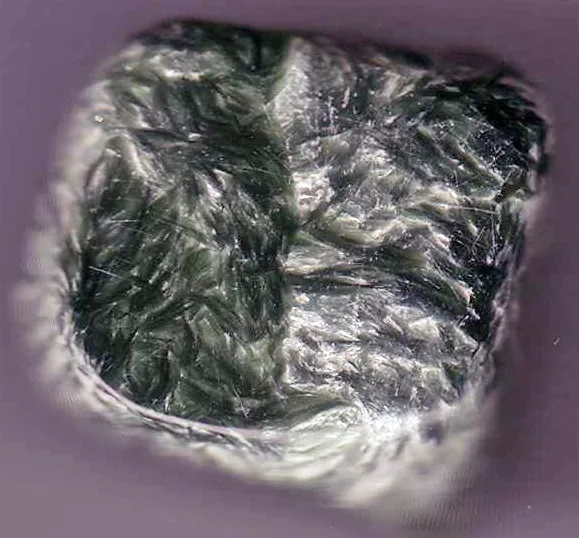
- Dyed chlorite leaves dark blotches in the cracks; a natural pattern is even and fibrous.
- Fibrous green serpentinite is cheap and often sold as seraphinite — its pattern is coarser and more banded.
Care
Seraphinite is extremely soft: a sharp edge, a ring claw, or keys in a pocket will mark it. Store it separately in a soft pouch. Clean with a dry or barely damp soft cloth only; never soak it, and keep it away from steam, ultrasonic cleaners and acids.
See also
Serpentinite
Chemical formula – (Mg,Fe,Ni,Al,Zn,Mn)₂₋₃(Si,Al,Fe)₂O₅(OH)₄
Hardness – 3–6
Colour – greenish-yellow, with mottling and veins
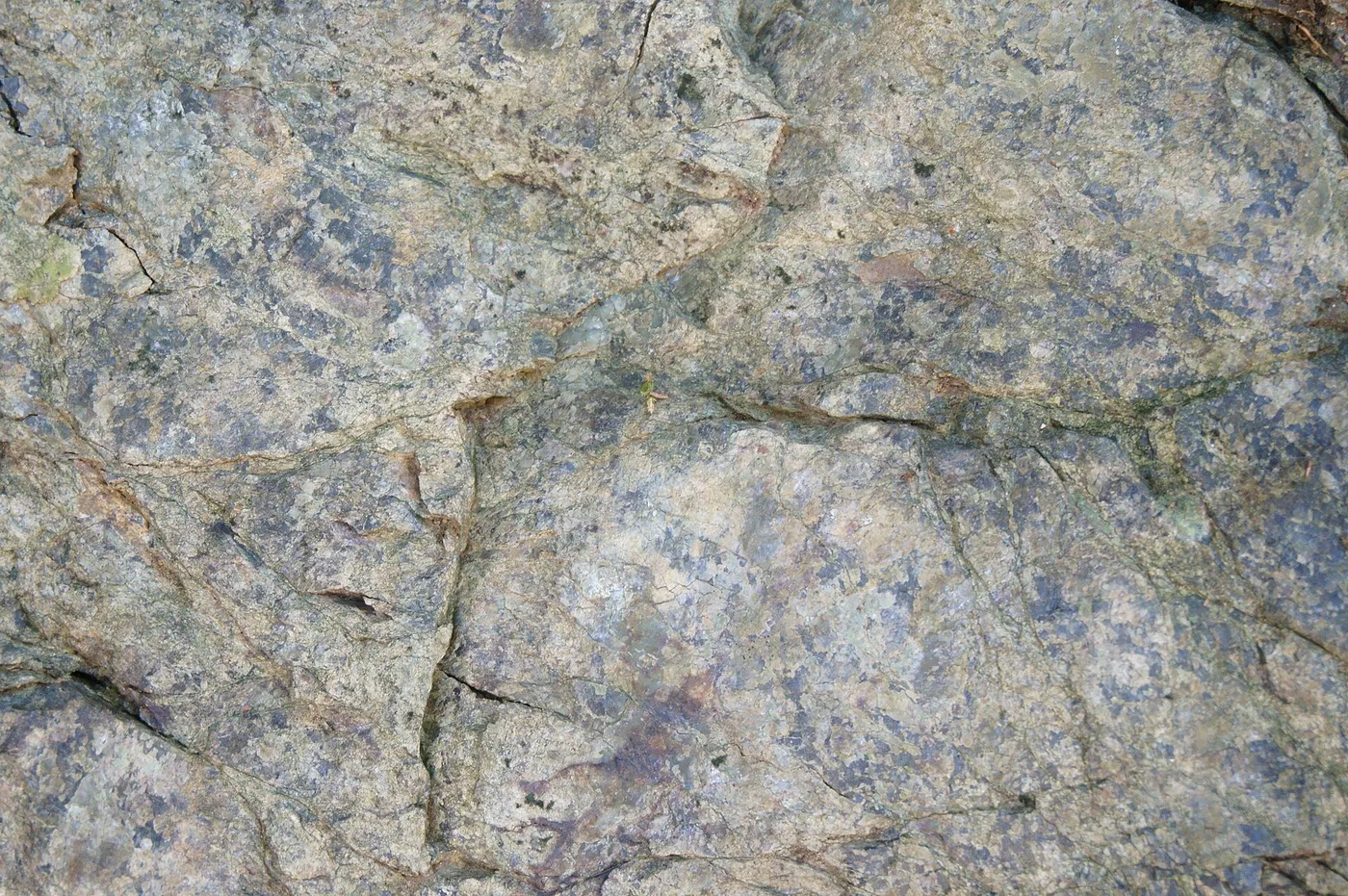
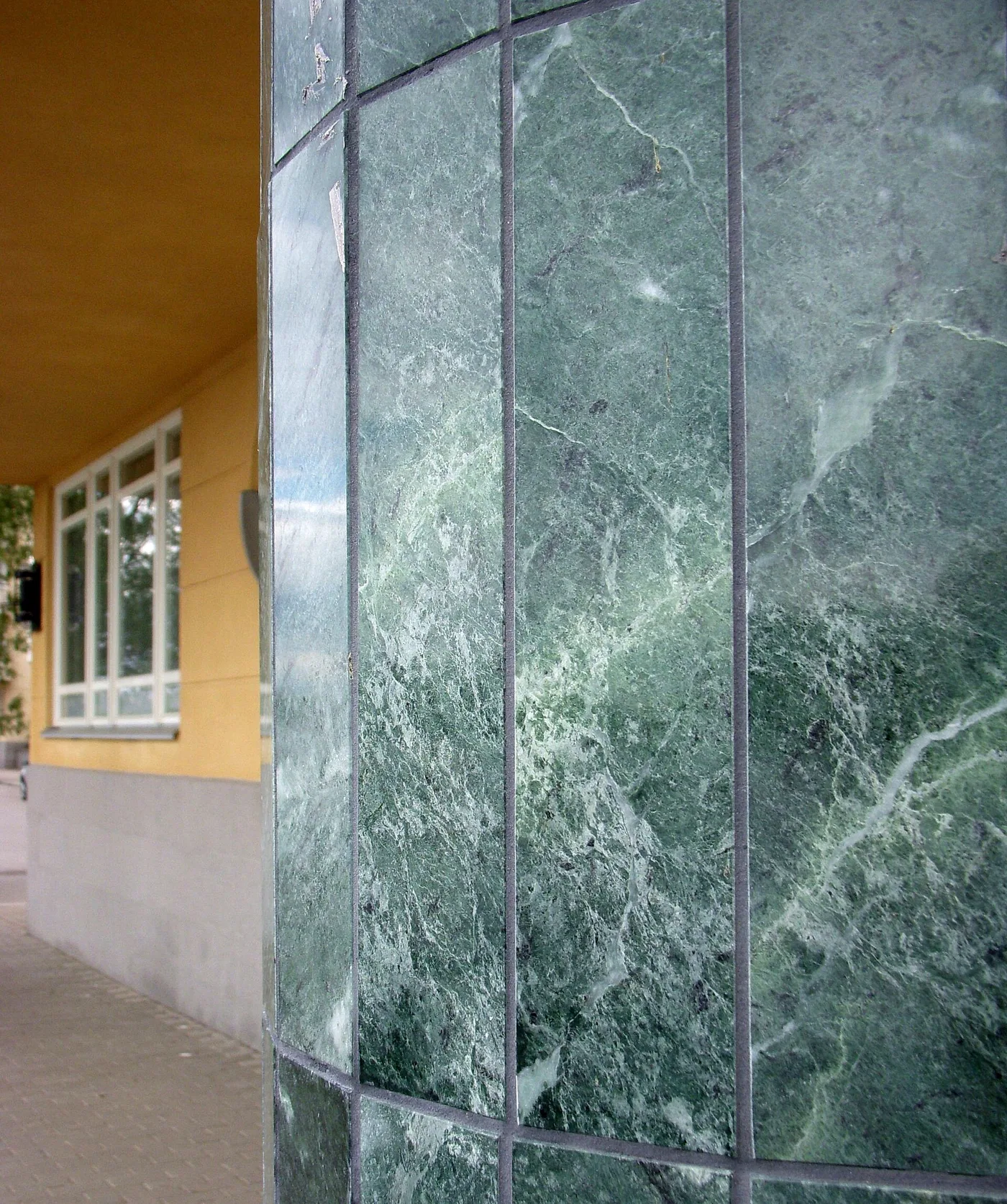
Serpentinite is a metamorphic rock made of two or more minerals — mainly lizardite, antigorite and chrysotile. Its pattern really does look like snake skin: yellow patches and thin veins spread across a blue-green ground.
The name comes from the Latin "serpens", a snake, and Russian calls the same stone zmeevik for the same reason. Because of its colour and structure serpentinite is widely used as a facing material, which keeps it cheap and available in large blocks.
For jewellery we cut only the dense, even part of the rock, the part that takes a good polish. Such a stone costs little but looks convincing — which makes serpentinite a sensible first green stone in any collection.
Origins
Serpentinite is common worldwide. Large deposits are worked in Australia, Russia — the Urals above all — England, India, New Zealand, and central and northern California.
Properties
Esoteric writers describe serpentinite as carrying strong, positive energy. It is said to help a person turn the rhythm and direction of their life towards something better.
The stone is often tied to Mother Nature. Practitioners recommend wearing it when someone is looking for the right path and for calm. It is considered especially helpful for hot-tempered, nervous and angry characters.
Traditional healing properties
Lithotherapists say serpentinite supports the cardiovascular system and helps the body recover after exertion.
This describes traditional practice, not medical advice. A stone does not replace a doctor.
Chakras
The root and heart chakras – muladhara and anahata.
Zodiac
Tradition links serpentinite to four signs — Gemini, Scorpio, Capricorn and Virgo. Some astrologers call it the key stone of Ophiuchus.
In Charcho jewellery
Serpentinite works well as a cabochon and as beads: the pattern reads on a flat surface, and the colour suits both silver and black metal. We have no ready-made piece yet, but we make them to order. Catalogue: bracelets.
Real or fake
- Bowenite and antigorite from the serpentine group are often sold as "New Zealand jade" — visually close, but not jade.
- Jade is denser and heavier with a greasy lustre; serpentinite is lighter and often shows pale veins at the surface.
- In dyed pieces the pigment collects in cracks — the green sits in patches rather than evenly.
- Safety matters: some serpentinite carries microscopic chrysotile fibres, which is asbestos. Never breathe the dust when sawing or polishing.
Care
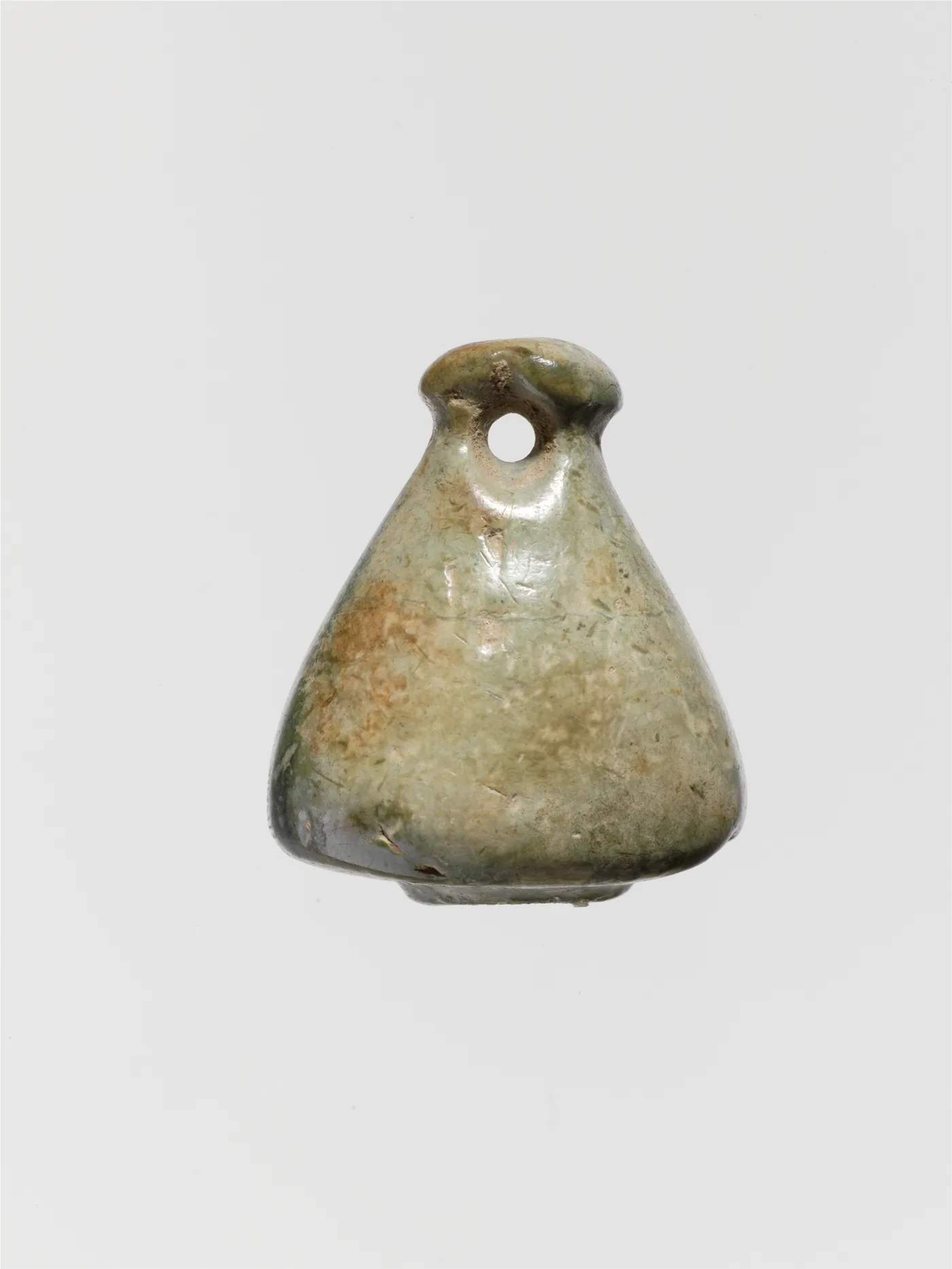
Serpentinite is comparatively soft, so store it on its own — other stones will scratch the surface. Warm water and mild soap are enough, but do not leave it soaking. Avoid acids, bleach and ultrasonic cleaning.
See also
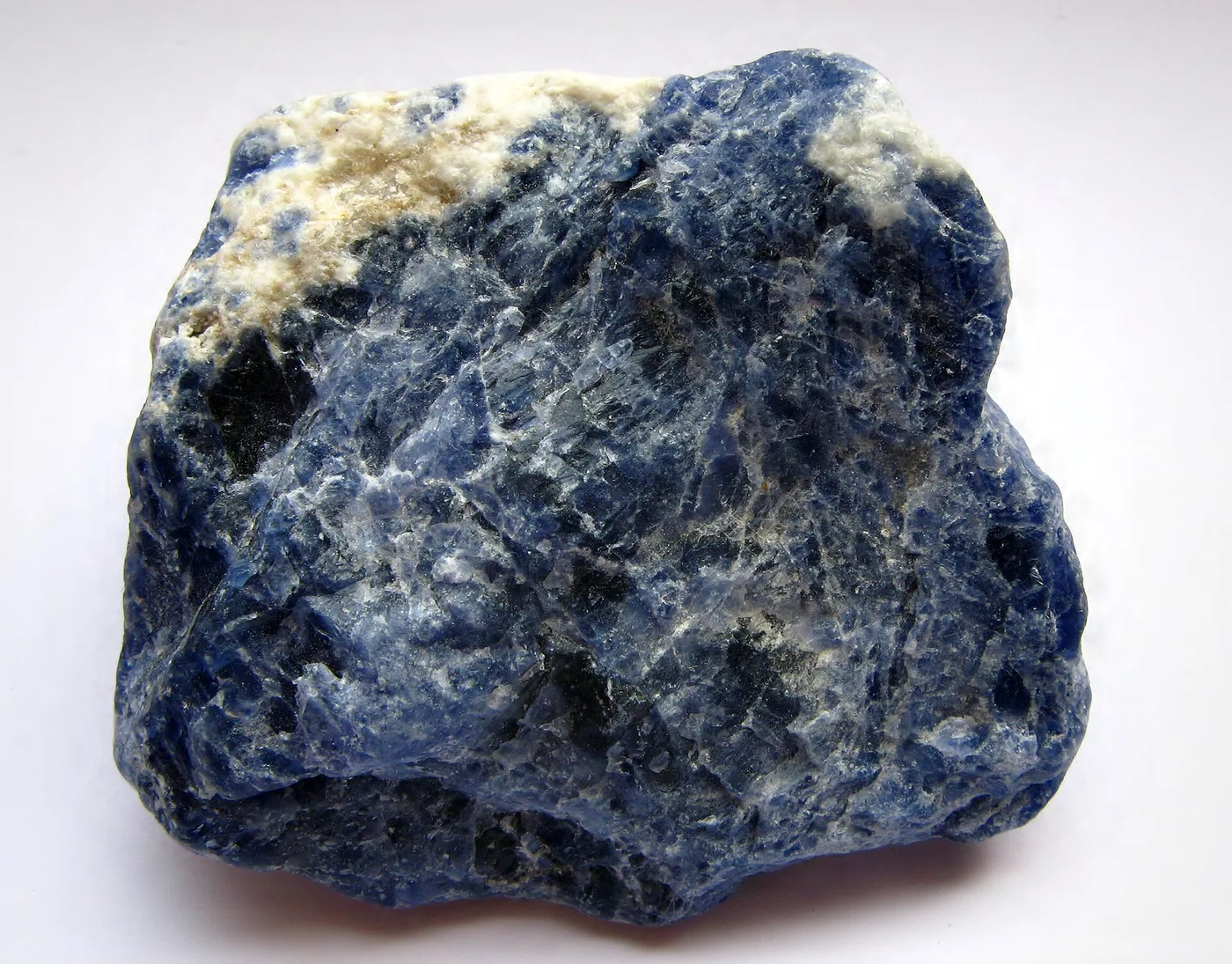
Sodalite
Chemical formula – Na₈(AlSiO₄)₆Cl₂
Hardness – 5.5–6
Colour – blue, sky blue, grey, white
Sodalite is a feldspathoid mineral. Its colour runs from a deep, restrained blue to pale sky blue, and the surface almost always shows white calcite veins or pale patches. Those veins are a natural signature: they are the simplest way to tell sodalite from lapis lazuli, which carries golden grains of pyrite instead.
The name refers to sodium — the stone was studied precisely because of its high sodium content. It was first found in Greenland in 1806. The blue comes from sulphur anions sitting inside the crystal lattice.
Sodalite has a curious relative called hackmanite, a variety of the same mineral that changes colour under ultraviolet light: it shifts from violet towards reddish and slowly returns to its original tone once the light is gone.
Origins
The largest suppliers are Brazil, India, Canada, Namibia, Russia and Greenland.
Properties
Sodalite is called the stone of logic, rationality and efficiency. It is believed to activate the mind and help a person think clearly.
Esoteric writers recommend it to anyone who needs to concentrate often — students, teachers, scientists. Shy and reserved people use it when communication is hard. It is said to be especially good when you have to stand in front of an audience.
Traditional healing properties
Lithotherapists consider sodalite useful for thyroid problems and hormonal imbalance, for the digestive system, for insomnia and for viral illness.
This describes traditional practice, not medical advice. A stone does not replace a doctor.
Chakras
The throat chakra – vishuddha.
Zodiac
Tradition links sodalite to Sagittarius, a sign drawn to knowledge and a wider horizon. It is also recommended to Virgo, since order and precision matter to both.
In Charcho jewellery
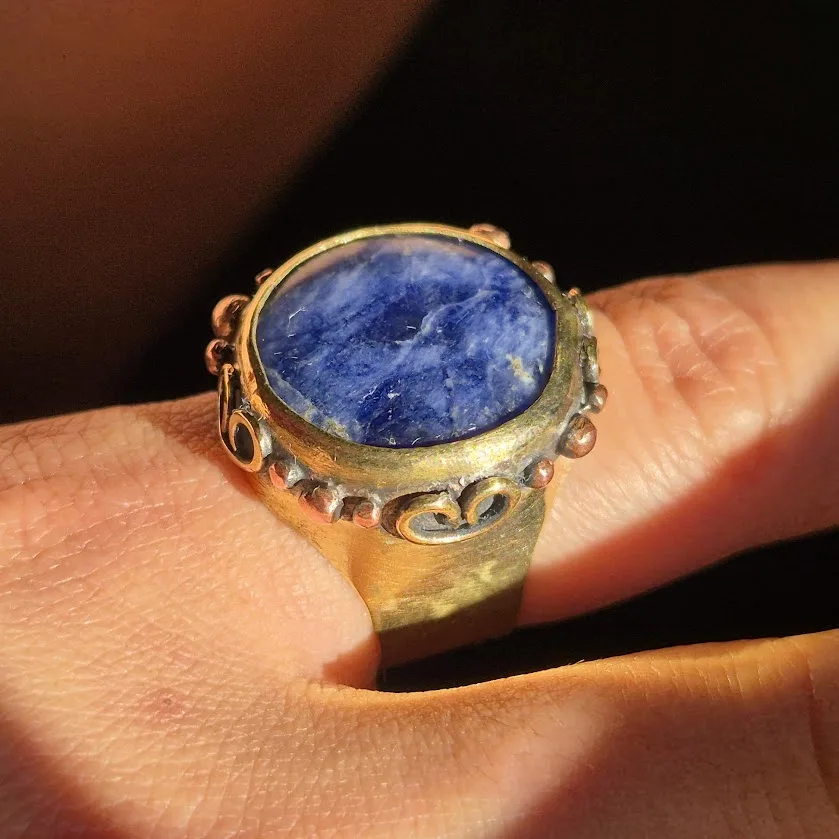
Blue works best with silver, so we usually set sodalite as a cabochon. The stone is dense and takes everyday wear well. We have no ready-made piece in the catalogue yet, but we make them to order. Catalogue: necklaces.
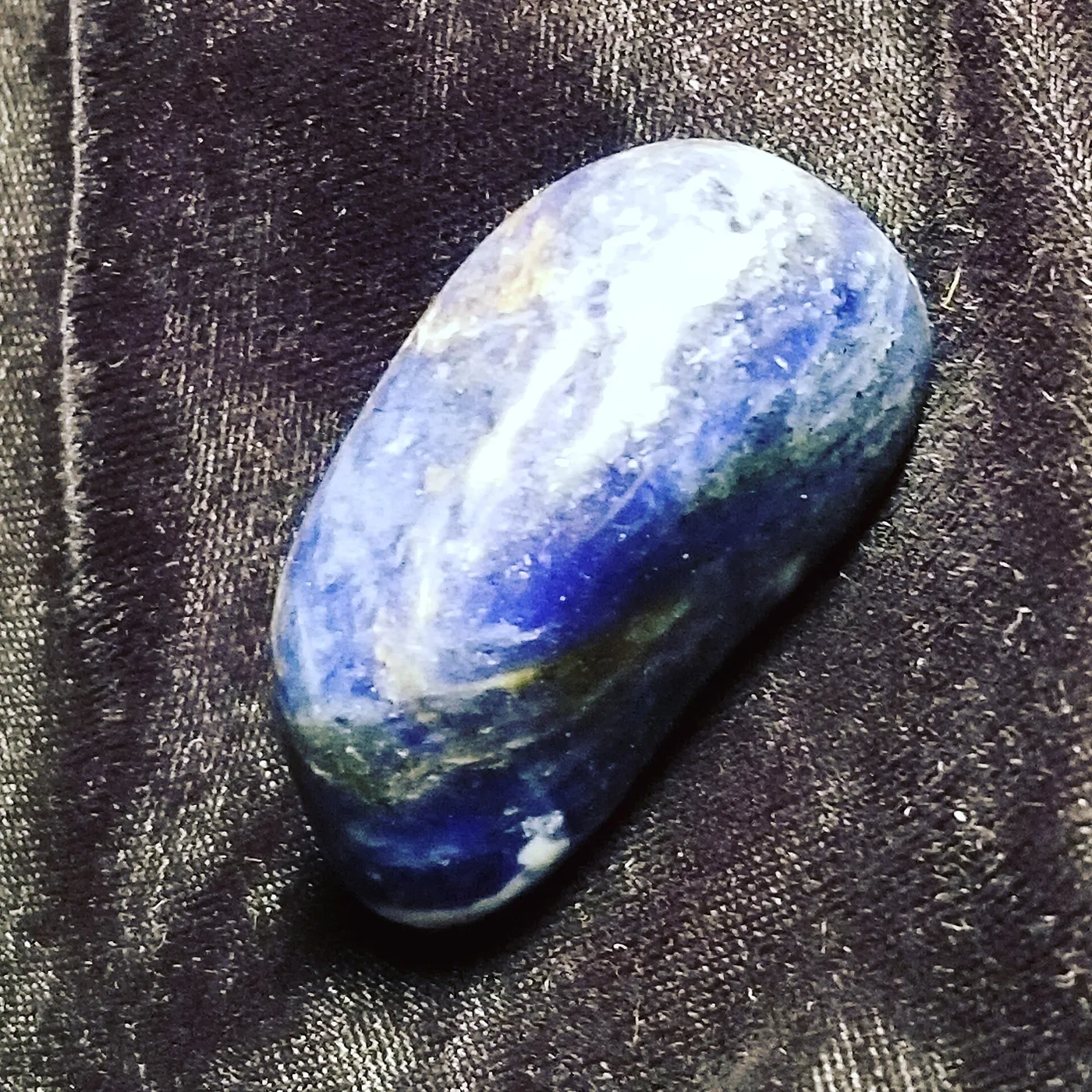
Real or fake
- Lapis lazuli comes with golden pyrite inclusions, sodalite with white calcite veins — the easiest distinction there is.
- Lapis is darker and more uniform; sodalite's blue is lighter and more "sky".
- The most common fake is dyed howlite or magnesite: the pigment settles in dark lines along the cracks.
- A glass imitation has no calcite veins but does show air bubbles.
Care
Hardness 5.5–6 allows daily wear, but the stone cannot take acid — sodalite dissolves in hydrochloric acid. Avoid household cleaners, steam and ultrasonic cleaning. Warm water, mild soap and a soft cloth are enough; long sun exposure dulls the colour.
See also
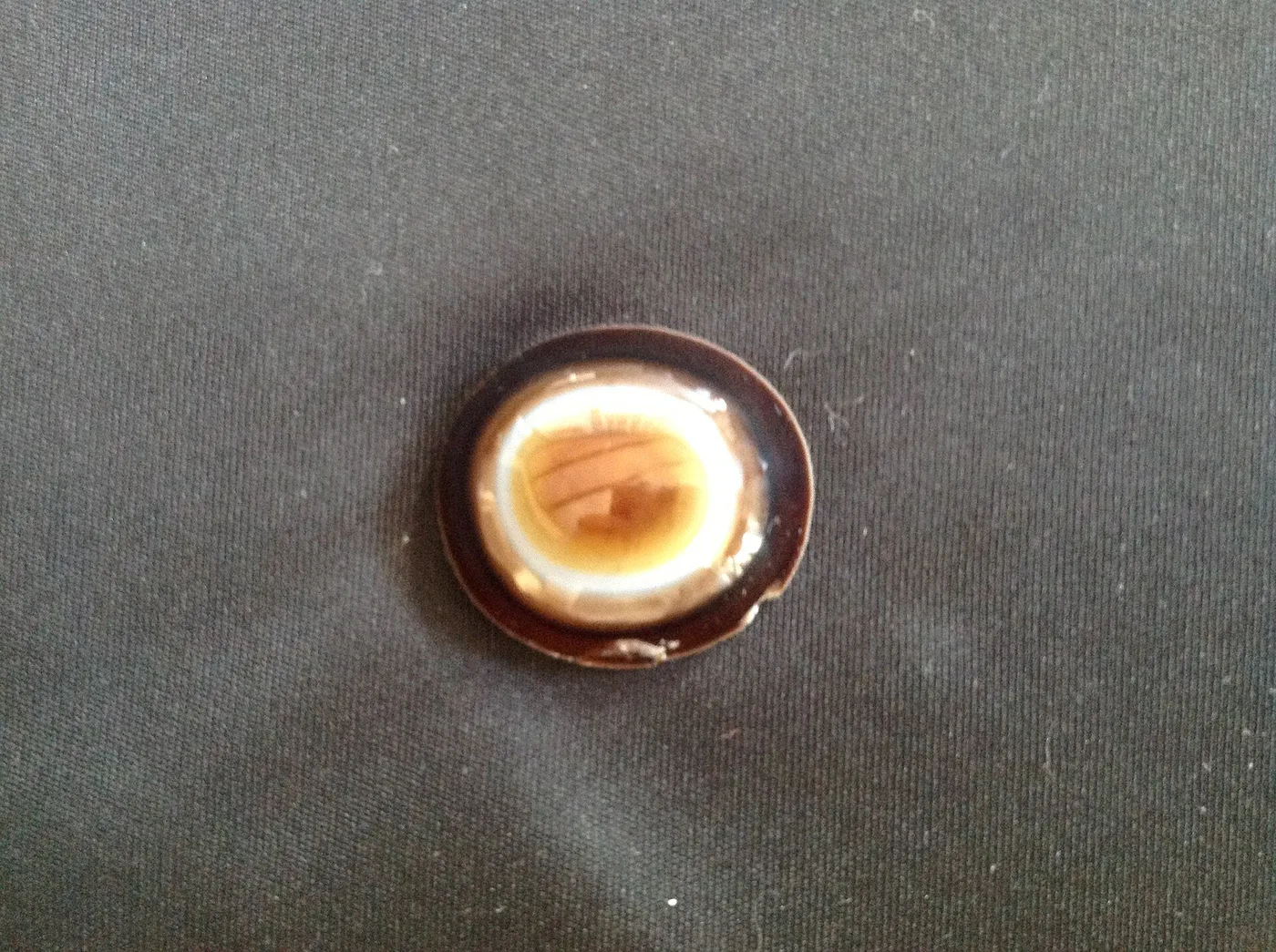
Sardonyx
Chemical formula – SiO₂
Hardness – 6.5–7
Colour – orange, red-brown with white bands
Sardonyx is a chalcedony and one of the varieties of onyx. Its signature is thick, almost straight layers: an orange, reddish or brown band gives way to white, and a single stone can hold three or four colours at once. Ordinary onyx is black and white; sardonyx stands out for these warm, reddish tones.
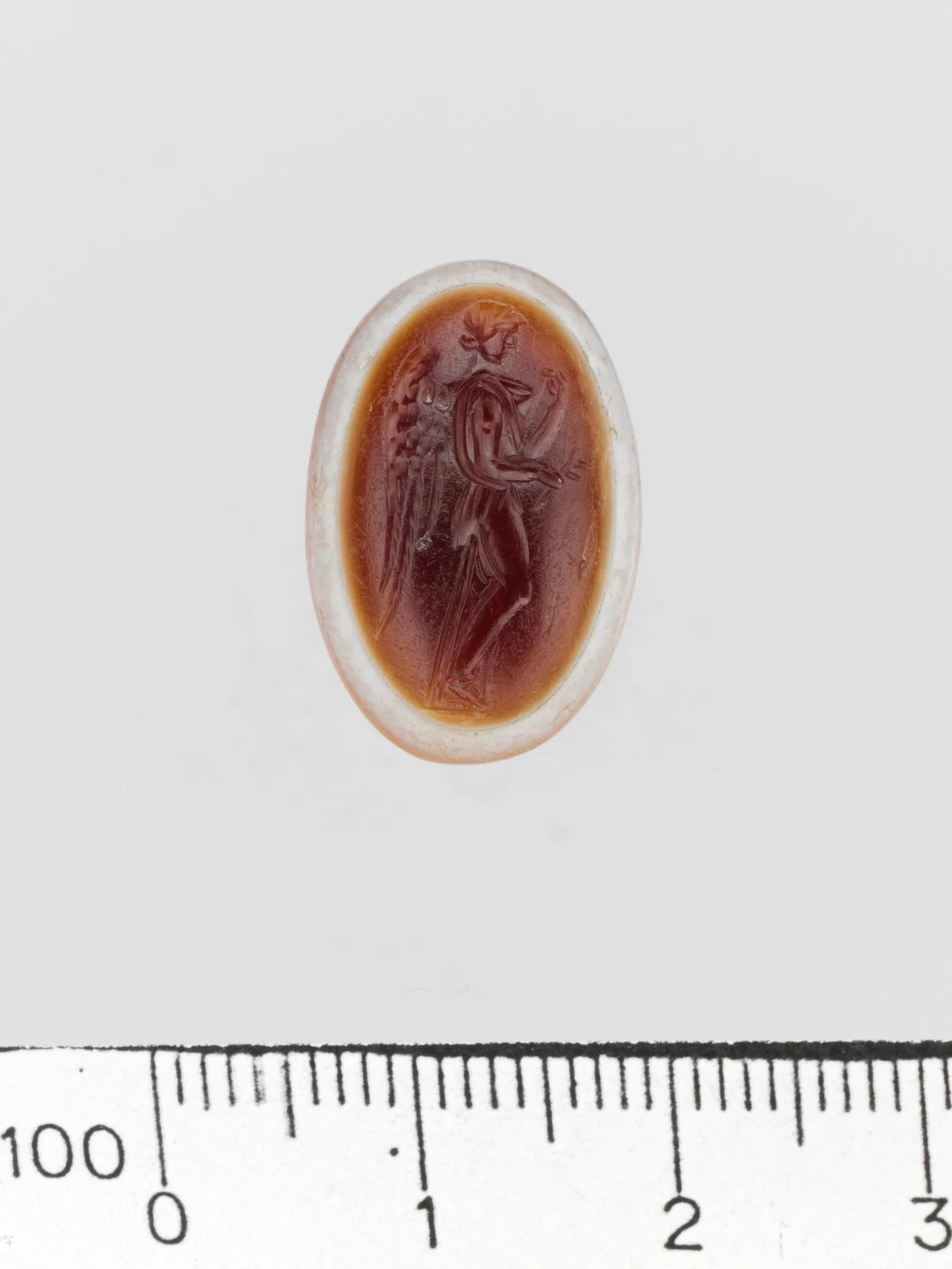
The name is built from two words — sard and onyx. In the ancient world sard meant the red-brown chalcedony, onyx the banded stone. Roman workshops cut signet rings from sardonyx: the seal was carved into the softer layer, and the harder layer protected it.
Three things set the price — the contrast of the bands, their thickness, and the cleanliness of the stone. Thick, sharply separated layers cost more than a soft, blurred transition.
Origins
The main source is Brazil, above all Rio Grande do Sul. The stone is also mined in Uruguay, India and Madagascar. Indian material often runs warmer and redder in tone.
Properties
Tradition gives sardonyx the character of onyx but adds the element of fire — the steadiness of earth and the energy of flame in one stone. It is said to add strength to its owner and to shield against other people's negativity. Most often it is used for grounding.
Esoteric writers consider sardonyx a good stone for someone full of ideas but short on motivation. It is said to help you see yourself clearly and come out of your shell.
Traditional healing properties
In the past healers used sardonyx to build energy and linked it to metabolism. Lithotherapists say it supports circulation and is kind to the lungs and bones.
This describes traditional practice, not medical advice. A stone does not replace a doctor.
Chakras
The first and second chakras – muladhara and svadhisthana.
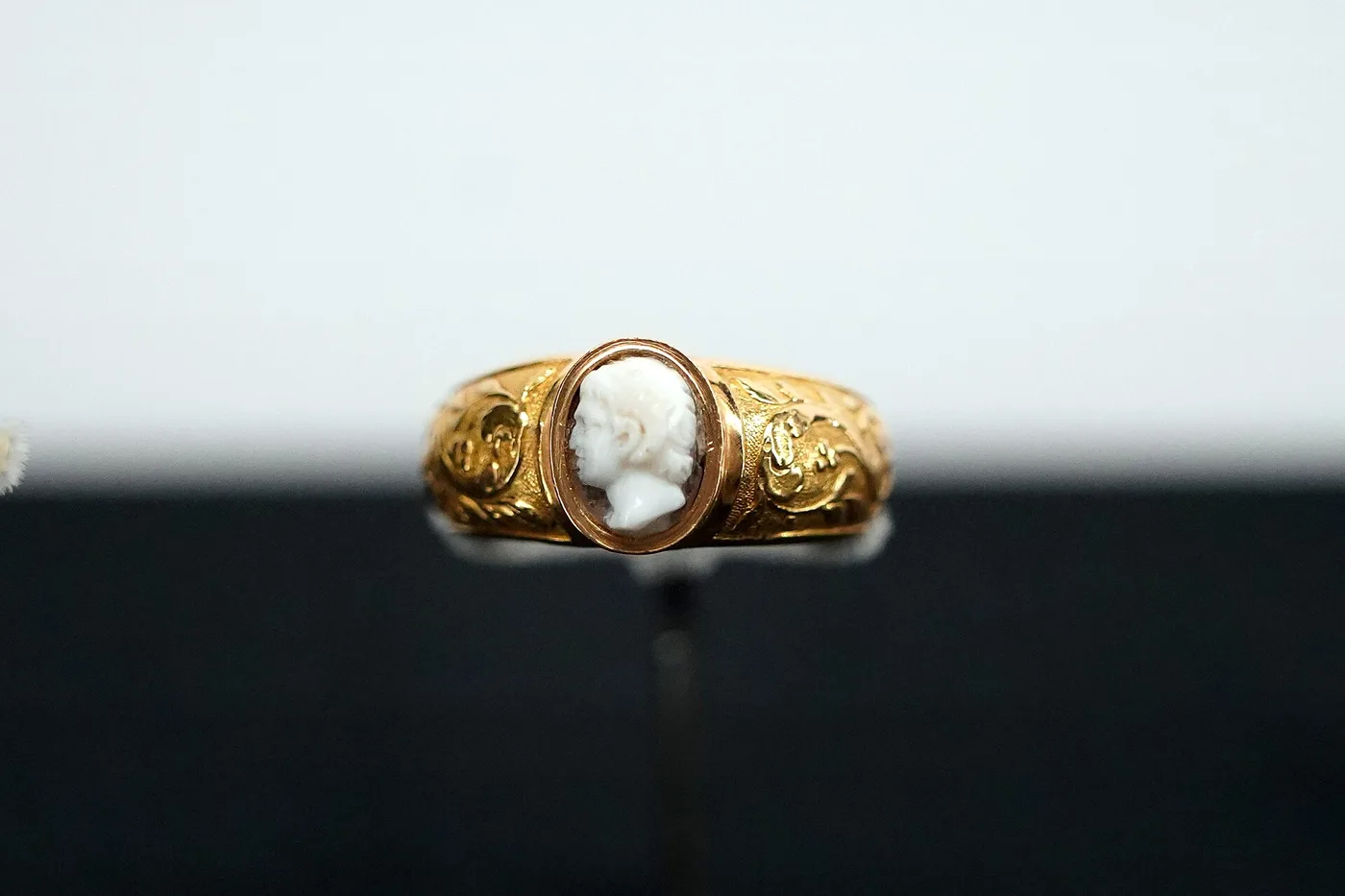
Tradition wears sardonyx as a bracelet or a signet ring so the stone stays in constant contact with the hand.
Zodiac
Tradition ties sardonyx to Leo and Virgo. Roman sources treated it as a stone of Mars, which is why some astrologers also recommend it to Scorpio.
In Charcho jewellery
A banded stone reads best as a cabochon — a flat surface does not hide the layers. Sardonyx usually goes into signet rings and men's bracelets. We have no ready-made piece in the catalogue yet, but we make them to order. Catalogue: rings.
Real or fake
- Sard and sardonyx are not the same stone: sard is an even red, sardonyx has bands.
- Natural layers are slightly wavy and bleed into each other; perfectly straight, ruler-like lines usually mean glass or glued slabs.
- In a dyed stone the pigment collects in cracks and pores — a damp white cloth will show it.
- Plastic imitations warm up quickly in the hand and feel light for their size.
Care
Hardness 6.5–7 allows daily wear, but the boundaries between layers are weaker than the rest. Warm water, mild soap and a soft cloth are enough. Avoid acids, long sun exposure and ultrasonic cleaning if the stone is dyed.
See also
Selenite
Chemical formula – CaSO₄·2H₂O
Hardness – 2–2.5
Colour – white, orange, brown, yellow
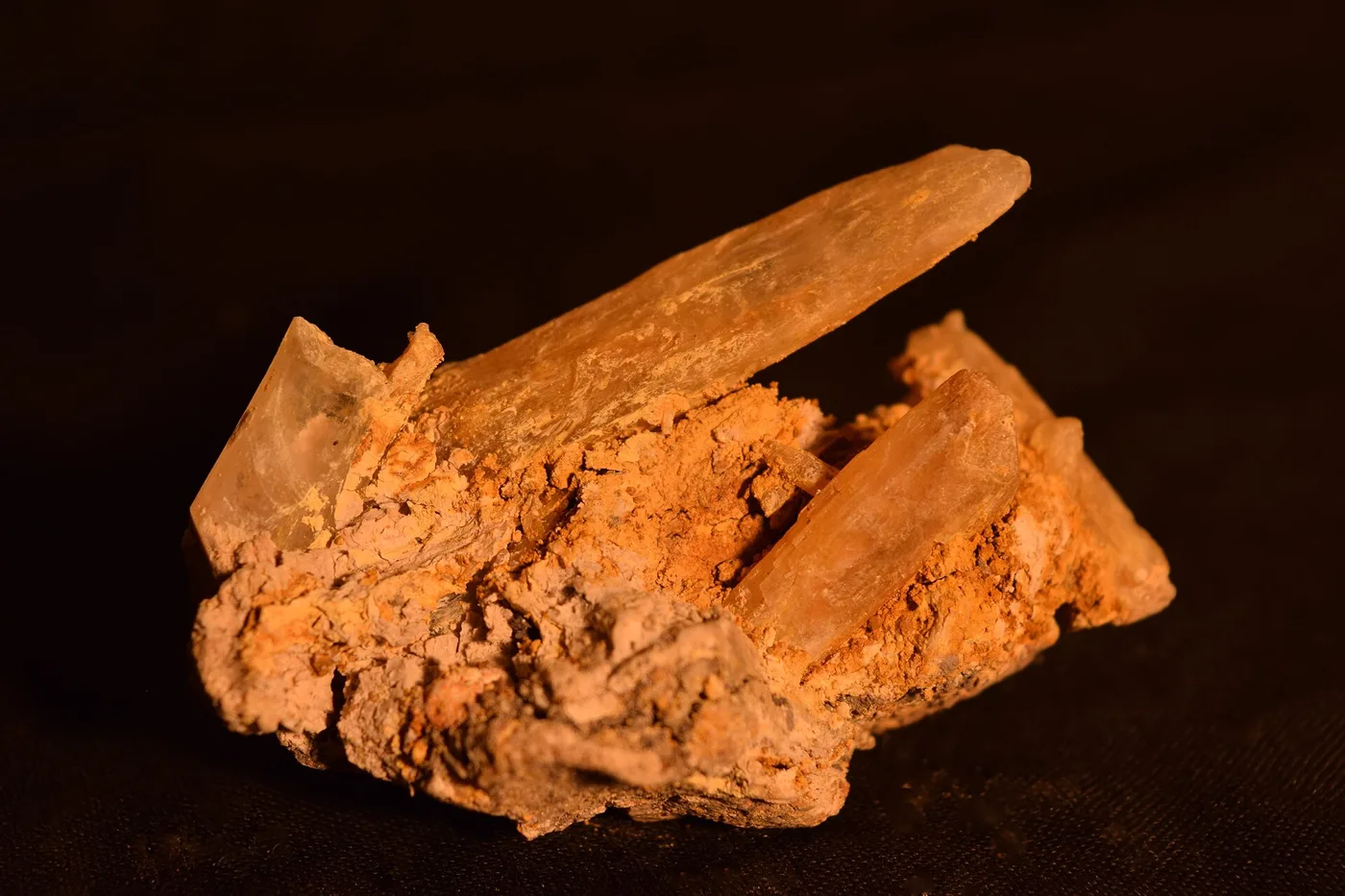
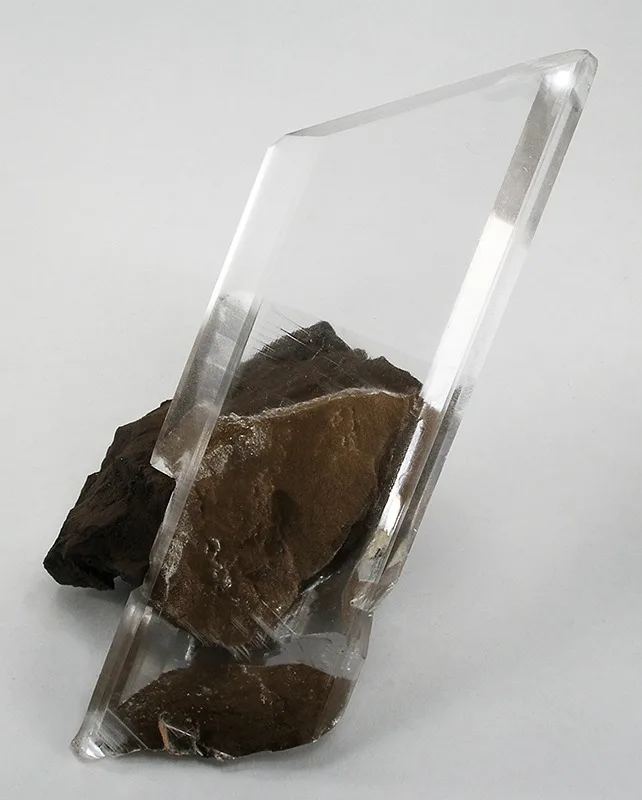
Selenite is the crystalline form of gypsum. It usually turns up as milky, semi-transparent blocks with fine silky fibres running through them. Those fibres give the stone its soft, cold shimmer — the look of moonlight on cloth.
The name comes from the Greek "selene", the Moon. Curiously, what shops sell as selenite is usually the fibrous variety, known in English as satin spar. Mineralogically it is the same gypsum, just with a different structure. Nature also makes "desert roses" — gypsum crystals shaped like a sand flower.
Selenite is far too soft for rings or bangles. It is a stone for the home, for a collection, or for meditation.
Origins
Selenite is mined in many countries. Well-known sources include Mexico — especially the Naica mine, where gigantic crystals were found — as well as Morocco, Spain, Poland, Germany, France, Russia, Australia and the United States.
Properties
Selenite is considered a very pure stone whose strong vibration brings light into a person's life. It is said to carry negative energy out of a home, which is why esoteric practitioners place it in room corners or on windowsills.
Esoteric writers say white selenite helps wake dormant gifts and talents. It is also often trusted with "cleansing" other stones — you simply lay the crystal beside them.
Traditional healing properties
Lithotherapists hold that selenite acts strongly on the kidneys, liver, gallbladder, stomach and intestines. It is said to strengthen bones, help you think quickly, and ease headaches and swings in blood pressure.
This describes traditional practice, not medical advice. A stone does not replace a doctor.
Chakras
The seventh chakra – sahasrara.
That is why selenite is often held above the head during meditation.
Zodiac
Tradition links selenite to Cancer and Taurus — both signs drawn to warmth and home. Some astrologers also recommend it to Pisces.
In Charcho jewellery
Hardness 2–2.5 rules selenite out for rings and bracelets: even a fingernail leaves a mark. We do not set it in jewellery, but we do use it in decorative frames. Catalogue: necklaces.
Real or fake
- Real selenite scratches easily with a fingernail, leaving a white line on the surface.
- Glass or acrylic imitations are much harder and feel colder and heavier in the hand.
- A natural block shows fine parallel fibres inside; a cast piece has none, or shows bubbles instead.
- The water test: real selenite slowly dissolves and the surface turns cloudy — so only try it on a piece that is already damaged.
Care
The main rule is simple: keep it dry. Selenite absorbs water and breaks down over time, so never wash or soak it and never wear it in the bath. A dry soft cloth is enough. Avoid damp rooms, salt and direct sun; steam and ultrasonic cleaners will also ruin it.
See also
Mother of pearl
Composition – CaCO₃ (aragonite) and conchiolin
Hardness – 2.5–4.5
Colour – white, grey, silver, yellow, blue, pink, brown
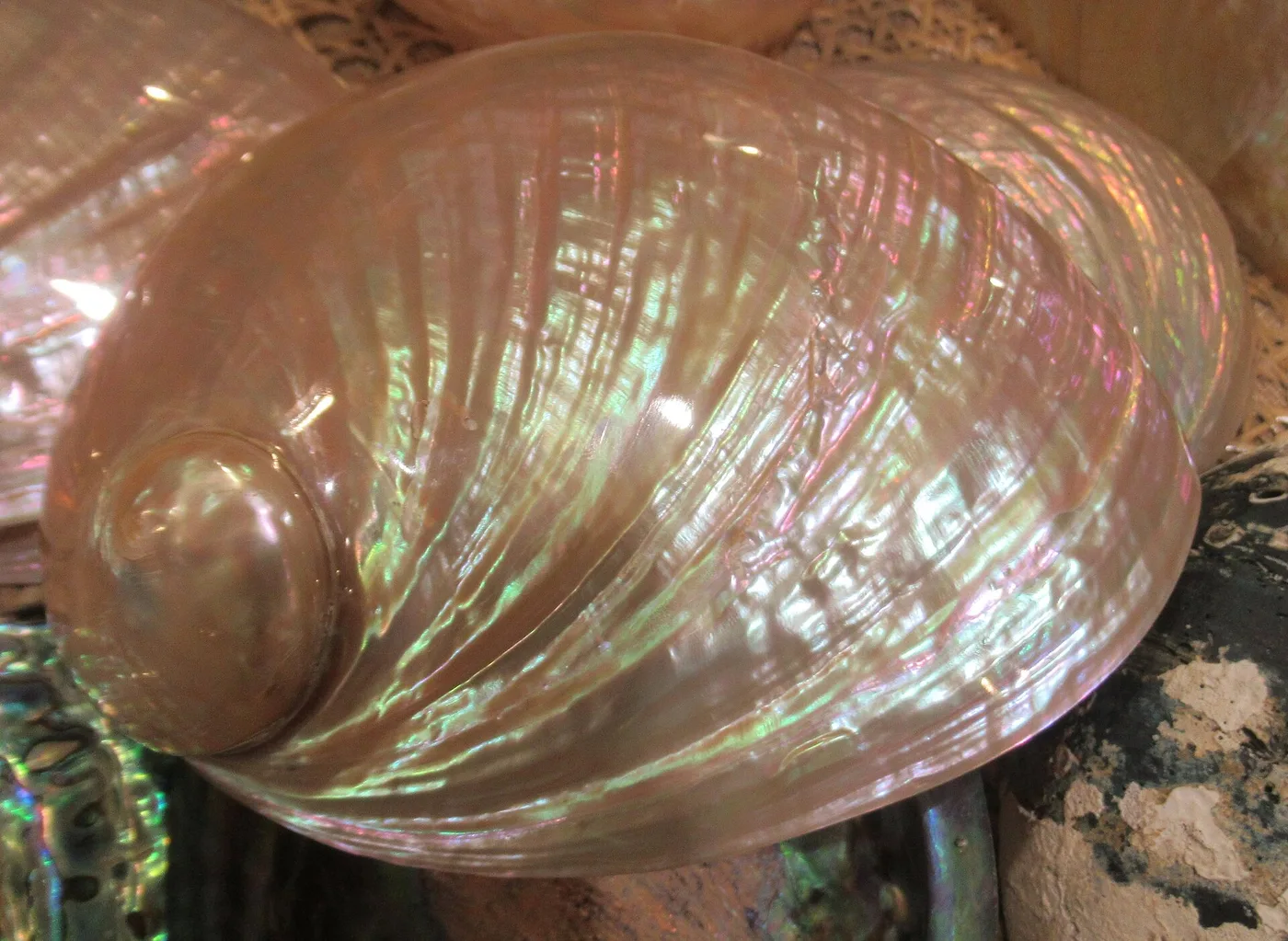
Mother of pearl counts as an organic stone. It is the inner lining of a mollusc shell, built from thin plates of aragonite. The plates lie at angles to one another, so light bends differently as you turn the piece and an iridescent sheen appears on the surface.
Mother of pearl is far more common than pearl. A pearl-producing mollusc always has a shell, but it forms a pearl rather rarely, which is why nacre is so much more available.
Its history is long. Mother of pearl was used by the Egyptians and Sumerians, and its mosaic work turns up often in the religious art of East Asia. In the West it became especially popular in the Victorian era: knife and fork handles, buttons, hair combs and other everyday objects were cut from it.
Today it goes into inlay, buttons, beads and marquetry. Price depends on the thickness of the layer and the strength of the sheen.
Origins
Mother of pearl, like pearl, is gathered all over the world. The largest suppliers are Australia, Japan, the United States, Madagascar, the Philippines and China.
Properties
Mother of pearl is believed to attract wealth and to sharpen intuition and imagination. Esoteric writers say it shields a person from negativity and works especially well for children.
It is said to clear a space and to keep harmony between people living under one roof. Memory is said to strengthen with its help.
Traditional healing properties
Lithotherapists hold that mother of pearl can regulate body temperature and blood pressure. It is also said to strengthen eyesight and brain function.
This describes traditional practice, not medical advice. A stone does not replace a doctor.
Chakras
Seventh chakra – sahasrara.
Tradition places mother of pearl at the crown and treats it as a stone of clarity and spiritual connection.
Zodiac
Mother of pearl is said to work especially well for Cancer and Gemini, though astrologers note that anyone can wear it. Tradition also links it to Pisces, since it belongs close to the water element.
In Charcho jewellery
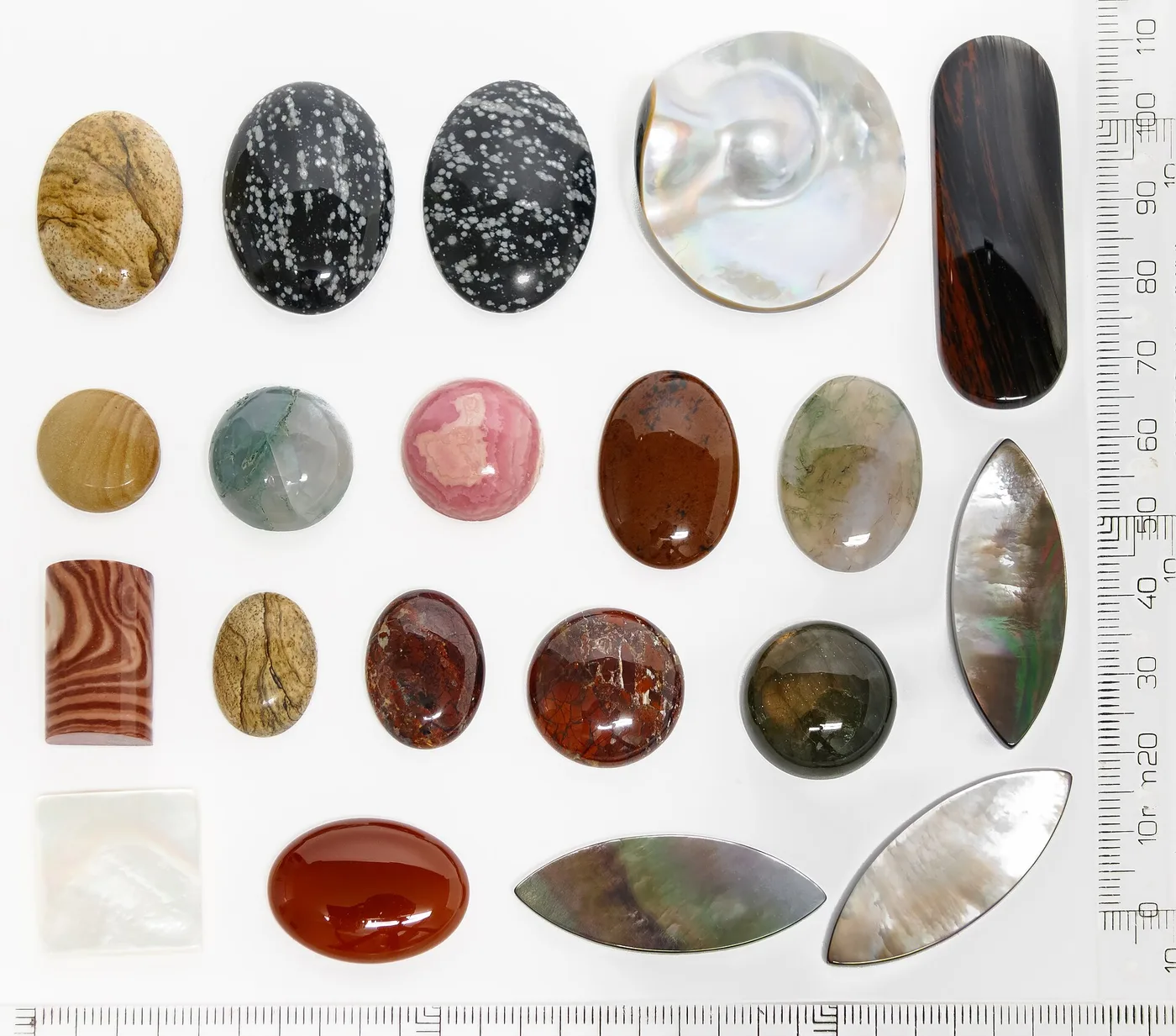
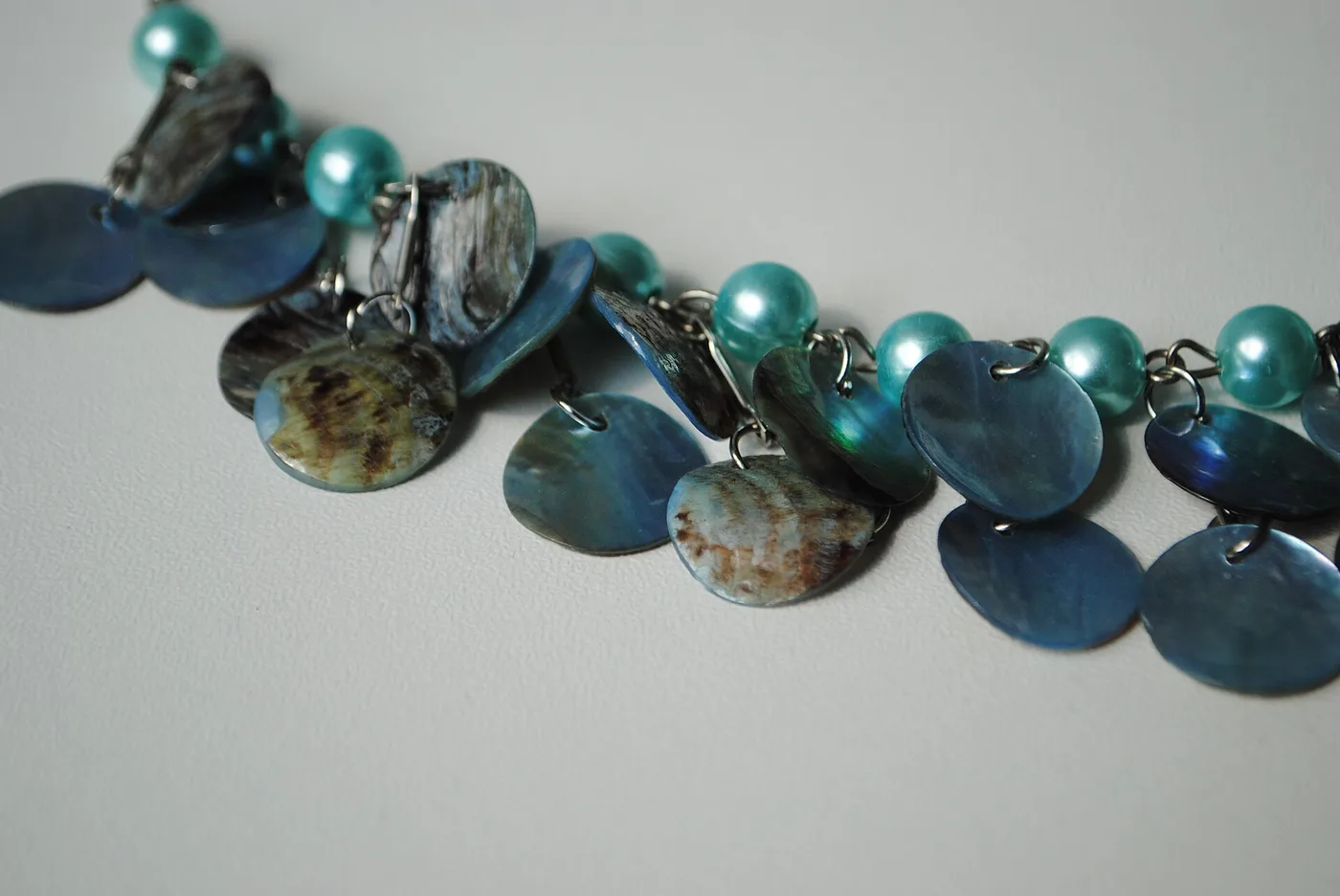
Mother of pearl is mostly used in inlay and flat plates, but small beads and inserts sit well in jewellery too. There is no ready-made piece in the catalogue yet, but we make them to order. Catalogue: necklaces.
Real or fake
- Mother of pearl is not pearl: nacre is the shell's inner coating, while a pearl is a separate formation growing in the mollusc's soft tissue.
- A plastic imitation is too even, warms in the hand and does not shift its sheen as you turn it. Natural nacre shows fine wavy lines and soft colour transitions.
- A composite of shell powder and resin gives itself away with bubbles and a surface that looks too clean.
- In dyed nacre the pigment collects in cracks and around the drill hole.
Care
Hardness 2.5–4.5 means nacre is soft and scratches easily: store it separately in a soft pouch. It is a carbonate, so vinegar, lemon, perfume and hairspray all damage it. It needs no ultrasonic cleaning or soaking — a damp soft cloth and a quick dry are enough.
See also
Sard and carnelian
Chemical formula – SiO₂
Hardness – 6.5–7
Colour – dark brown, red, carrot, yellow
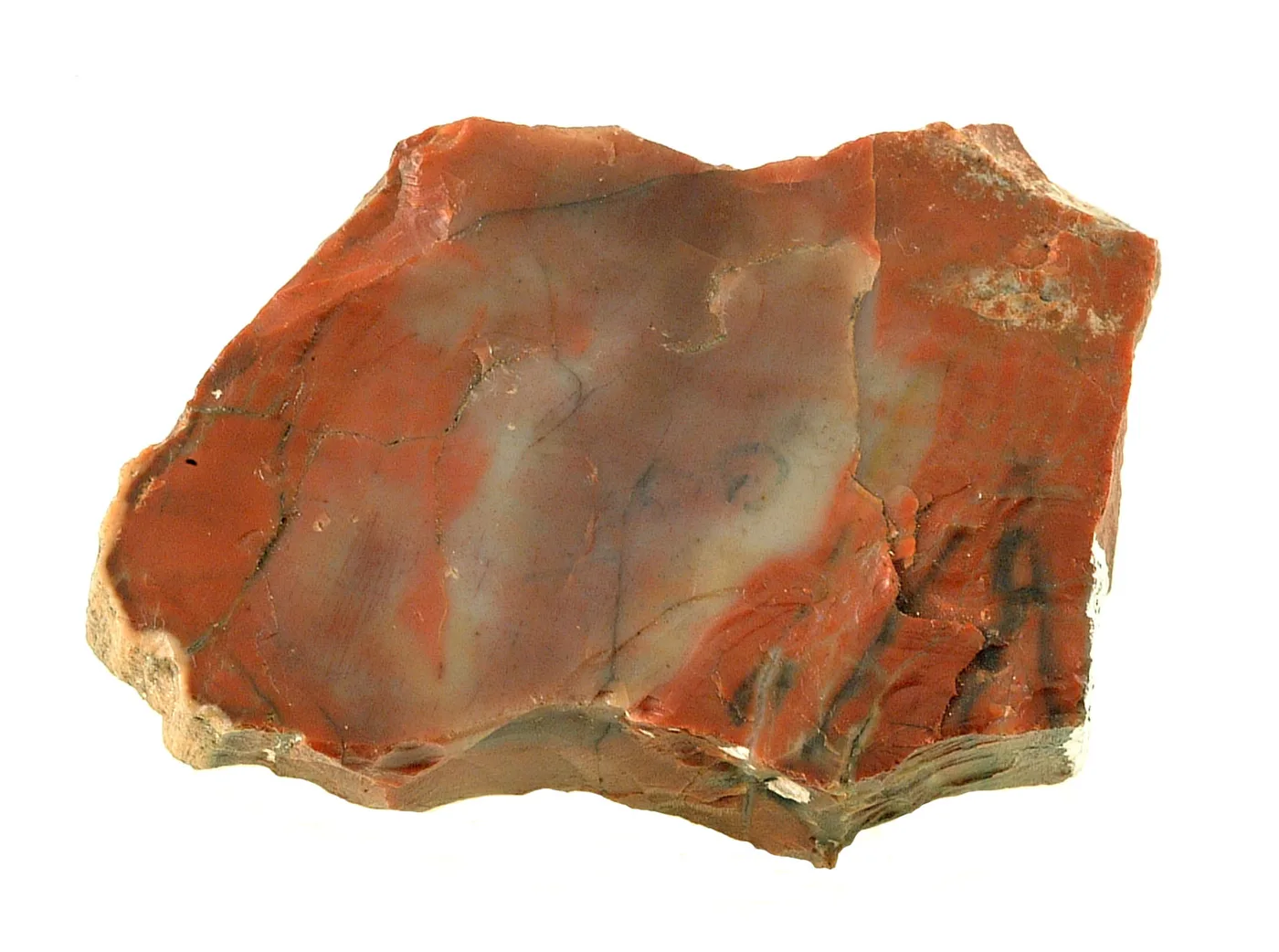
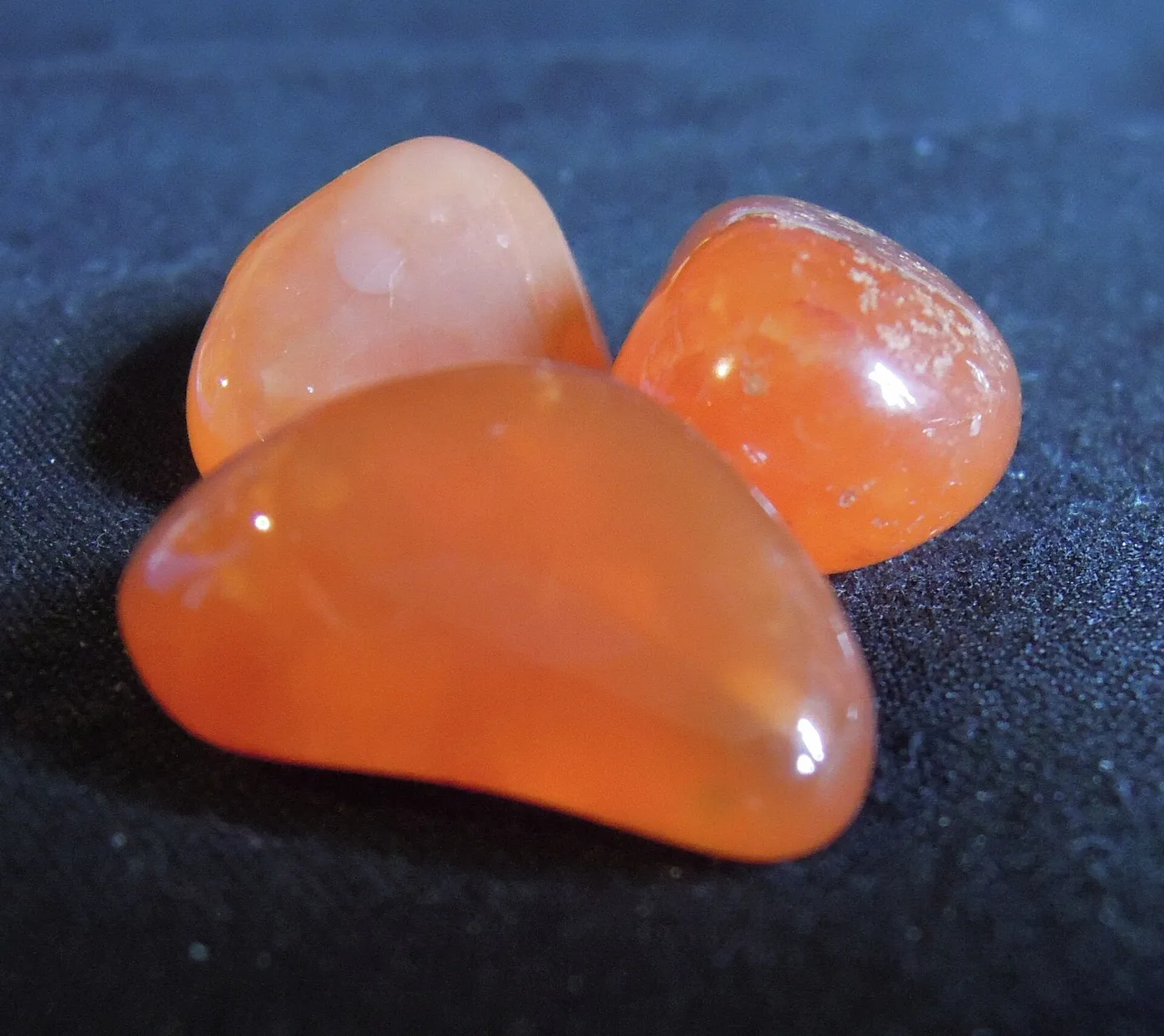
Sard is a variety of chalcedony, which is to say microcrystalline quartz. Iron gives it its colour: dark brown, brick red, carrot and yellow tones blend freely inside one stone.
The name is traditionally traced to the ancient city of Sardis in Lydia, in what is now Turkey. In Latin the stone was "sardius", and it appears in sources 4,000 years old.
Sard and carnelian are the same material: carnelian is the lighter, orange-red stone, sard the darker, browner one. The banded version is a separate stone, sardonyx. Traders often swap these three names for one another.
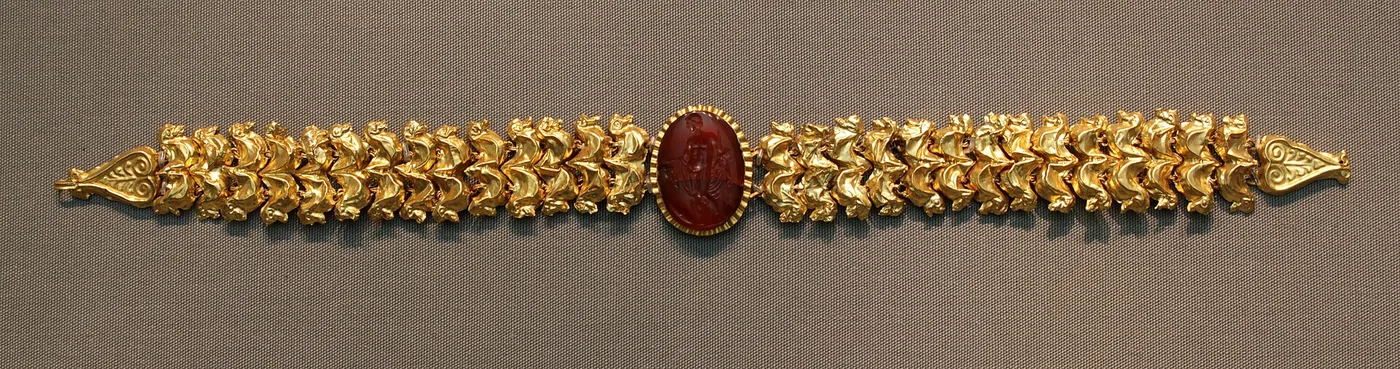
Sard is one of the oldest stones people wear. It appears in biblical texts, on the high priest's breastplate and among the foundations of Revelation. It was also chosen for seal rings: wax does not stick to polished sard, so the impression came out clean.
Origins
The largest deposits of sard are in Brazil, Uruguay, India, Madagascar and the United States.
Properties
For centuries sard was worn as a protective stone, and people believed it lent endurance and staying power. It remains one of the best-known stones today.
Modern esoteric writers hold that it gives a person the drive and strength to be a leader. The carrot-coloured sard is called an excellent aid to study, and is said to turn a listless, low-energy person into one full of life and joy.
It is considered the stone of architects, builders, military personnel, journalists, writers and teachers. In the past people believed sard brought income, new opportunities and luck; today it is often used in the workplace, where it is said to lessen pressure from colleagues and strengthen ambition.
Traditional healing properties
In older practice sard was used on wounds, and it was believed to act well on skin disease. Lithotherapists use it for sepsis, toothache, poor eyesight, and for problems of the heart, blood vessels and digestive tract.
This describes traditional practice, not medical advice. A stone does not replace a doctor.
Chakras
First and second chakras – muladhara and svadhisthana.
Sard's earthy, warm colour is tied in tradition to the base, to stability and to life energy.
Zodiac
Tradition makes sard a Leo stone: a sign that takes leadership naturally matches the stone's reputation for courage. It also suits Virgo and Capricorn, who value work and results.
In Charcho jewellery
Sard works as cabochons, beads and signet stones — the dark colour sits well with gold. There is no ready-made piece in the catalogue yet, but we make them to order. Catalogue: necklaces.
Real or fake
- Sard and carnelian are often heat-treated to deepen the colour. That is standard trade practice rather than fakery, but naturally dark stone is rare and expensive.
- In dyed chalcedony or agate the pigment shows in cracks and between bands; the colour looks too even and flat.
- A glass or resin imitation has bubbles and a mass that is too clean and uniform.
- If a smooth, single-colour stone is sold as "sardonyx", the name is wrong: sardonyx is defined by crisp, straight bands.
Care
Hardness 6.5–7 allows daily wear. Warm water and mild soap are enough; long sun, heat and acids damage the colour. A dyed piece dislikes ultrasonic cleaning.
See also
Rhodonite
Chemical formula – (Mn²⁺,Fe²⁺,Mg,Ca)SiO₃
Hardness – 5.5–6.5
Colour – pink, reddish, brown, with black inclusions
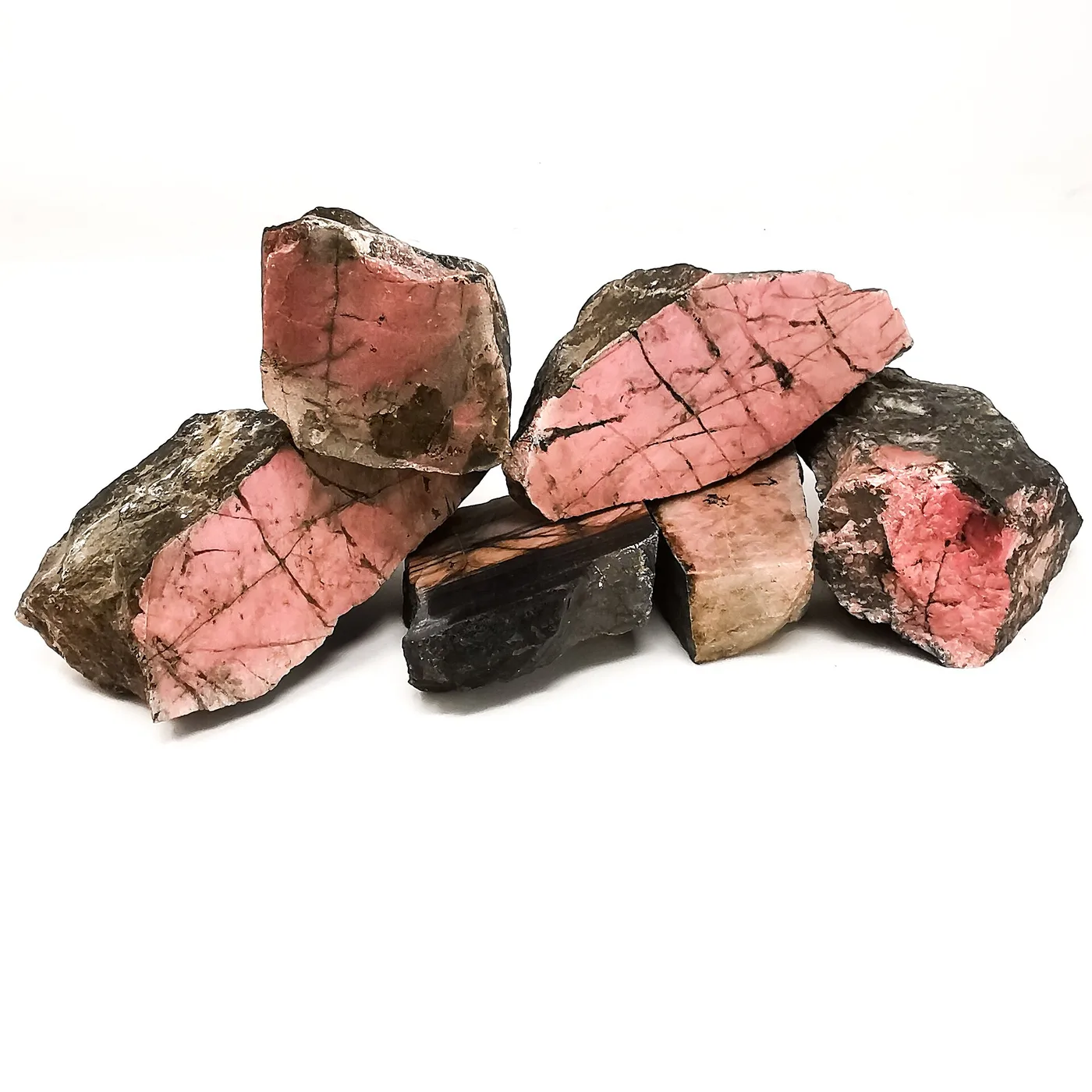
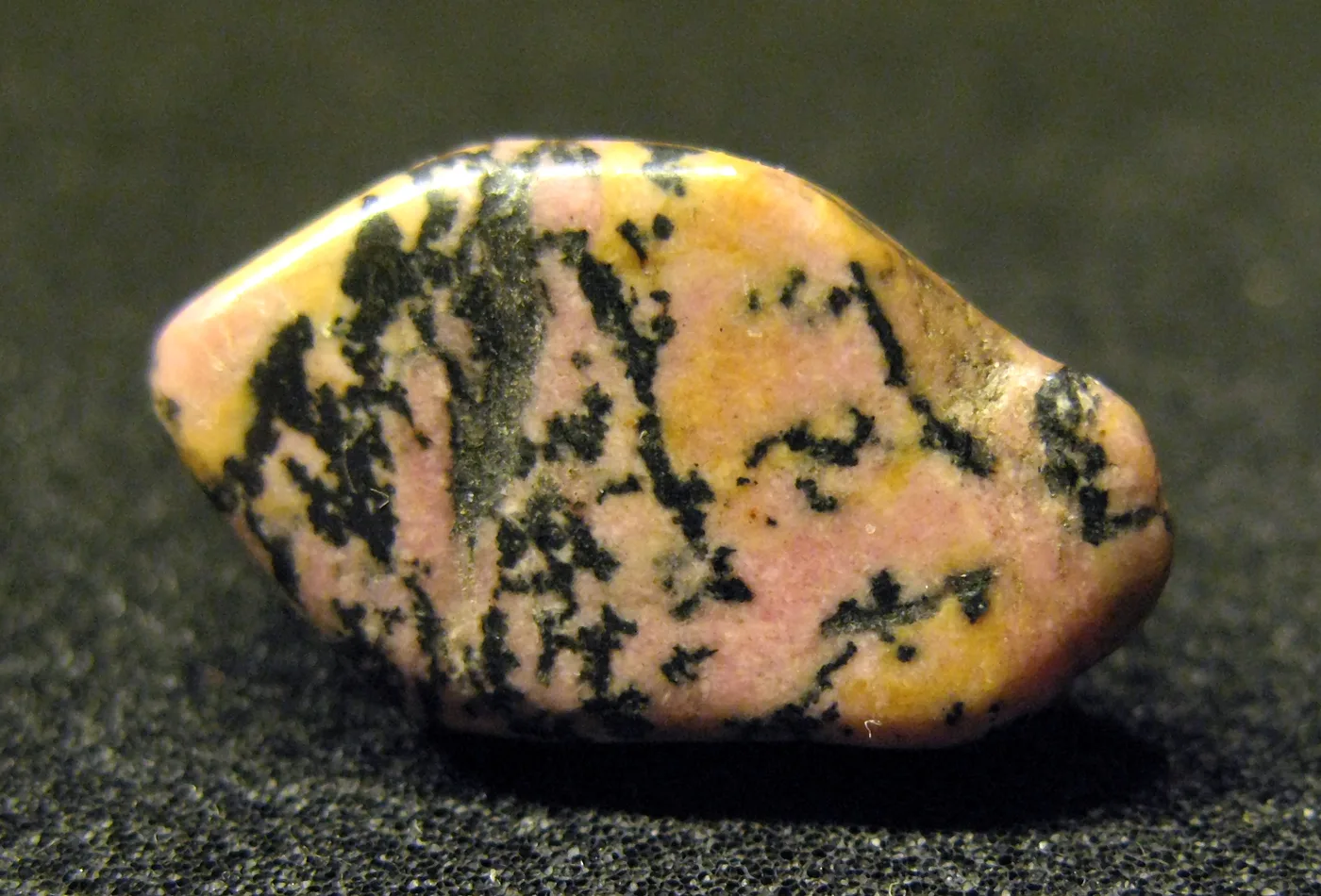
Rhodonite is a chain silicate that carries manganese, and that element is what gives it the pink-red colour. Its signature is the black, curving veins and patches: manganese oxide inclusions that build a web across the pink ground.
The name comes from the Greek "rhodon", a rose. The same root gives us rhodolite and rhodochrosite, which is why all three are easily confused in a shop. Rhodonite is almost always opaque; transparent pieces are rare and prized by collectors.
Price follows the pattern. Ordinary beads are cheap; a large cabochon with crisp black veins on a clean pink ground costs more. An even pink stone with no veining usually turns out to be another material.
Origins
Rhodonite is mined in Australia, Finland, Japan, Canada, Madagascar, Russia, Sweden, Tanzania and the United States. The Russian deposits have a long reputation for especially fine material.
Properties
Rhodonite is counted among the strongest emotional healers. Esoteric writers say it helps a person use their full potential and reach success. It is called the stone of purpose, goals, cooperation, altruism and generosity.
It is believed that rhodonite eases a life of overloaded schedules and constant stress, and that it calms an explosive character and makes it more durable. It is said to teach love for others and to work well for restless children.
Tradition treats rhodonite as one of the strongest calming stones, applied equally to children, adults and a room. People in the arts are told it helps them past laziness and creative block.
Traditional healing properties
Lithotherapists treat rhodonite as a stone that restores energy. It is said to be good for immunity, the nervous system, arthritis, the lungs and the bones.
This describes traditional practice, not medical advice. A stone does not replace a doctor.
Chakras
Fourth chakra – anahata, the heart.
At the same time, because of its pink tones, some practitioners also link rhodonite to the lower chakras and credit it with an earthy, settling energy.
Zodiac
Tradition makes rhodonite a Taurus stone: a sign that wants stability and a tangible result suits the stone's grounded character. It also works for Aries, where the stone takes the edge off excess aggression, and for Libra, for whom harmony is personal business.
In Charcho jewellery
Rhodonite looks good as beads: the black vein pattern spreads evenly over a round surface and gives a necklace a lively look. We do not have a ready-made piece in the catalogue yet, but we make them to order. Catalogue: necklaces.
Real or fake
- Rhodonite is most often confused with rhodochrosite. Rhodochrosite is a carbonate, softer (hardness 4) and usually banded in white and pink; rhodonite has black veins and a higher hardness.
- The pink banded "rhodonite" that sells very cheaply is often dyed banded calcite, the so-called Mexican onyx. The dye gathers between the bands and inside cracks.
- A resin-and-chip composite gives itself away with surface bubbles and an unnatural gloss.
Care
Hardness 5.5–6.5 is middling, so the stone needs care against knocks and sharp edges. Warm water, mild soap and a soft cloth are enough; keep acids, ultrasonic cleaning and steam away.
See also
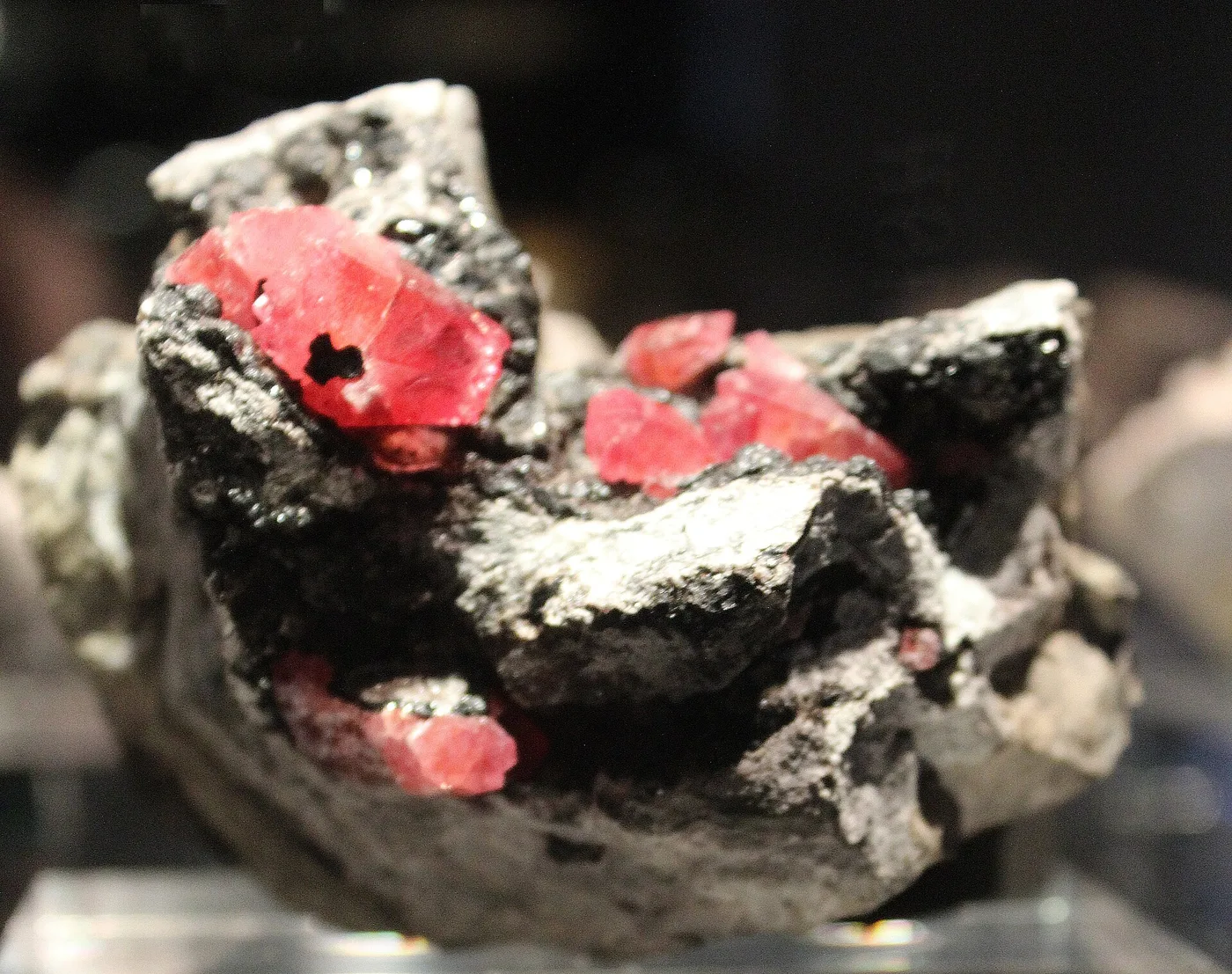
Rhodochrosite
Chemical formula – MnCO₃
Hardness – 4
Colour – pink, red, brownish
Rhodochrosite is manganese carbonate, and it takes its pink from that manganese. The range runs from pale pink to scarlet and dark brown, while the stone's most recognisable feature is its white-and-pink wavy banding.
The name comes from the Greek "rhodokhros", meaning rose-coloured. The Inca believed the stone was the petrified blood of their former kings and queens, which is why it was called the rose of the Inca (Rosa del Inca). In Argentina its stalagmites have been known for centuries.
Rhodochrosite appears both as crystals and as massive banded pieces. Transparent raspberry-red crystals are rare and expensive; ordinary banded stone stays affordable.
Origins
Rhodochrosite is the state stone of Argentina and of Colorado, where it is mined in large quantities. It is also found in Chile, Mexico, Peru, South Africa, Romania and Hungary.
Properties
Esoteric writers say rhodochrosite strengthens self-esteem and confidence and brings calm, joy and harmony into a life. It is called the stone of meditation and concentration.
It is said to balance love between people and to help its owner draw gentle feelings. It steadies mental and emotional processes and is often called the stone of freedom. To a creative person, esoteric sources say, it awakens possibilities.
Traditional healing properties
Traditionally healers used rhodochrosite for problems of the digestive system, the heart, the kidneys, the spleen, the pancreas and the thyroid. It is also said to help with stress-related complaints.
This describes traditional practice, not medical advice. A stone does not replace a doctor.
Chakras
First and fourth chakras – muladhara and anahata.
Tradition puts pink stones at the heart, while an earthy, carbonate nature belongs to the base and to stability. Rhodochrosite is therefore treated as a bridge between the two.
Zodiac
Tradition makes rhodochrosite a Leo stone: a sign generous with attention and warmth matches the stone's reputation for opening the heart. It also suits Taurus and Scorpio, whose feelings run deep and intense.
In Charcho jewellery
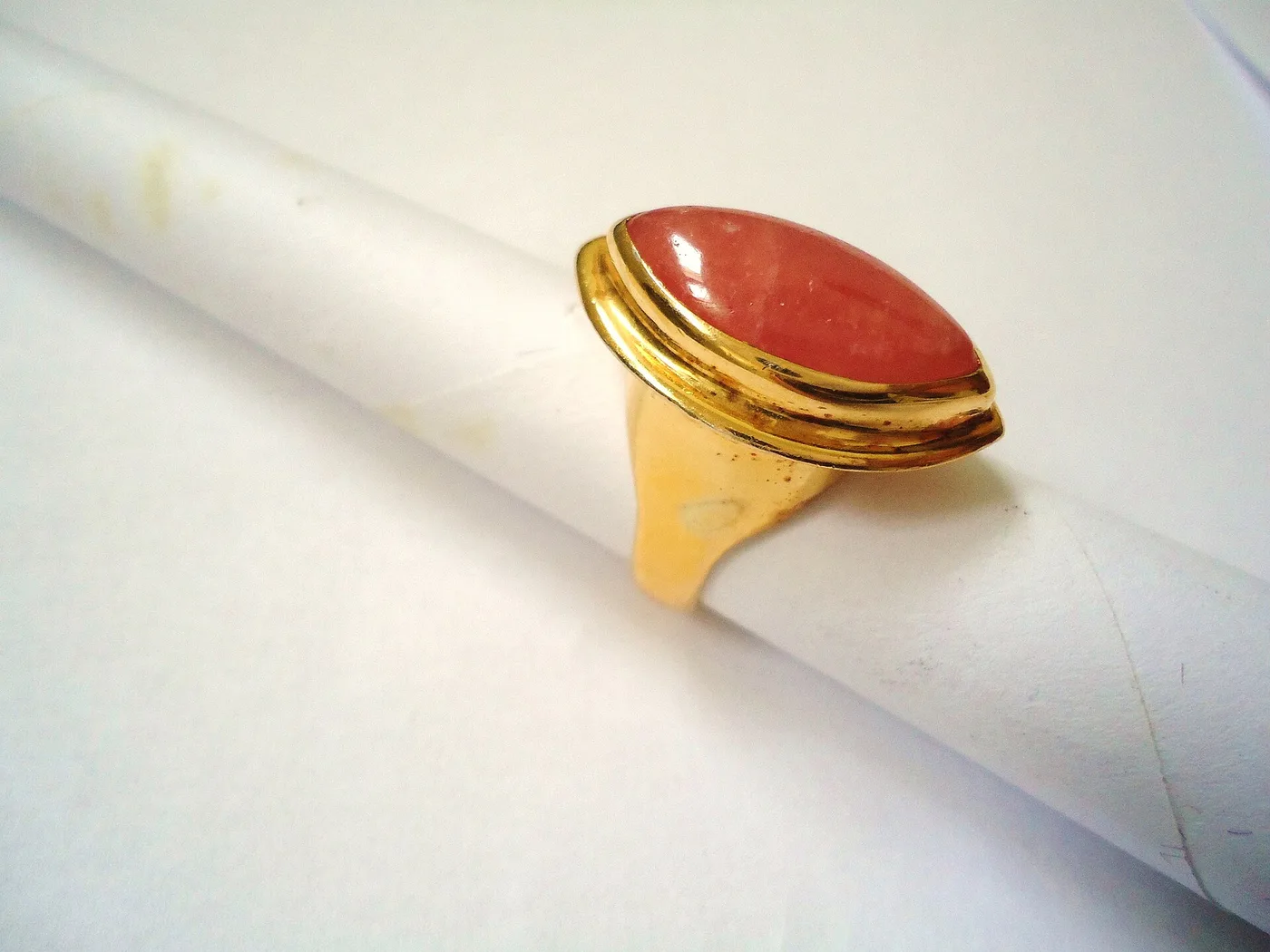
A banded piece of rhodochrosite looks good as a cabochon, but given its hardness it sits more safely in a necklace or earrings than in a ring. There is no ready-made piece in the catalogue yet, but we make them to order. Catalogue: necklaces.
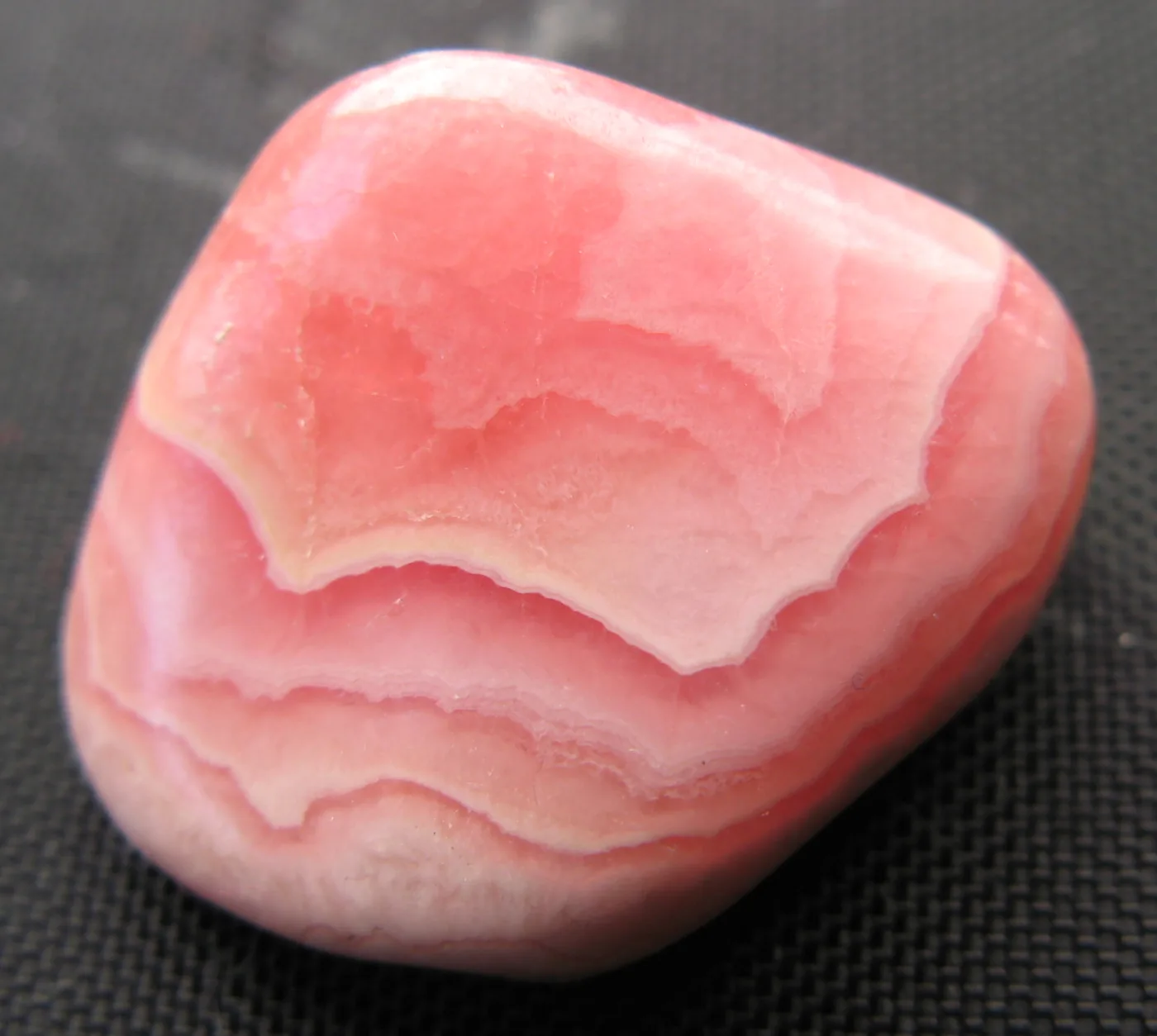
Real or fake
- Rhodochrosite is often confused with rhodonite. Rhodonite is a silicate, harder (5.5–6.5) and veined in black; rhodochrosite is soft and shows white-and-pink bands.
- A cheap, very bright pink banded stone is often dyed calcite. A simple check: on a drop of vinegar calcite starts fizzing at once, while rhodochrosite reacts far more slowly.
- A resin-and-chip composite gives itself away with surface bubbles and an even, dead gloss.
Care
Hardness 4 means the stone is soft: keep it away from sharp edges and harder jewellery. As a carbonate it is sensitive to acids (vinegar, lemon, perfume), so it needs no ultrasonic cleaning, steam or long soaking — a slightly damp cloth and a quick dry are enough.
See also

Have an idea? We will make it.
Write or call us - together we will choose the material, colour and size, and make the piece to order.