 Free Delivery in Batumi


Blog
From the workshop: materials, care, gifts and the stories behind the pieces.
-
Batumi humidity and leather
In Batumi, Sakartvelo, the air is damp for most of the year, and in summer the coastal moisture is joined by heat. Leather is a living material: it breathes and takes moisture from its surroundings. That is why a leather piece here needs different care than in a dry climate, not more frequent care but more attentive care.
What humidity does to leather
Leather absorbs moisture at fibre level. From outside it is barely visible, but the piece becomes heavier and softer. When there is plenty of moisture and the air does not move, the fibres stay wet for a long time. In that period leather is at its most vulnerable: it stretches easily, creases easily and picks up smells easily.
On the other hand, humidity protects leather from drying out. The difficulty of the Batumi climate is not the damp itself, but that a piece often sits in a closed, unventilated place.
Mould: how it starts
Mould spreads by spores and looks for moisture and darkness. The first signs are a whitish or greenish bloom in the folds and near seams, and a smell you notice the moment the bag opens.
What to do: take the piece into the air, in the shade, without a hairdryer, and let it dry. Then lift the bloom carefully with a soft dry cloth, outdoors, so the spores do not stay in the house. The surface can be wiped with slightly diluted vinegar, and afterwards a colourless conditioner goes on, because vinegar adds dryness.
What not to do: no brush, no bleach-based products, no hot air. If mould has gone into the leather or the colour has turned patchy, show the piece to a craftsman.
Deformation: leather stretches
Wet leather takes a shape more easily than anything. A bag soaked in the rain and left hanging by its handle will stretch over time; a belt always fastened at the same hole creases exactly there. An overfilled wallet loses its corners.
The answer is simple: a wet piece always dries flat or in its natural shape, with paper inside, never hanging.
Daily habits
- Never keep a bag in the bathroom, where humidity is highest.
- When you get home, open the bag and leave it open for an hour.
- Rotate your bags: leather needs rest.
- In the cupboard, a moisture absorber and cotton bags, not polythene.
- Direct airflow from an air conditioner dries leather, but ventilating the room is good.
The long rains
In Batumi, days of steady rain are ordinary. A bag comes home wet and there is not always a chance to leave it open all day. Two things are enough: paper inside, and a window open overnight. By morning the leather is dry.
Once a month, look the bag over: seams, corners, where the handle attaches. An early sign is easy to correct; a late one is already a repair.
See also
-
Leather history: from craft to luxury
Leather is older than the wheel and older than writing. For most of its life it was a cheap, rough material: it kept thorns out of a foot, held water on a journey, made a strap that did not snap. It reached the display case fairly recently, and the price tag is now explained by hand-stitching rather than by usefulness. Between those two points the road has a few clear bends.
The oldest trace
A hunter found in the Alps — known today as Ötzi — lived around 3300 BCE. His cap, coat and shoes were leather: bearskin soles, uppers laced with lime bast. Those pieces have held their shape for more than five thousand years. It is the strongest argument leather has, and we have never found a better one.
Earlier still, in the Stone Age, hides were worked with smoke, fat and brains. In ancient Egypt leather became sandals, bags and waterskins, and alum was already used to dress skins. Excavations at Pompeii uncovered workshops where hides were processed — by the first century CE this was a city trade, not a household chore.
A craft kept outside the walls
In medieval Europe the tanner and the shoemaker sat in different guilds, with different prices and different standing. Tanning happened by the river, outside the town wall: it needed water, and the smell was not welcome indoors. Hides soaked in oak-bark liquor for months. That slow process produced the material we now call vegetable-tanned leather — and it is why old leather ages the way it does.
Chrome and the sewing machine
In 1858 Friedrich Knapp patented chrome tanning in Germany; in the 1880s Augustus Schultz worked out the two-bath process. Tanning fell from months to days. At the same time the sewing machine, spreading through the 1850s, took over part of the stitching. Together they turned a craft good into a product almost anyone could buy.
How it became luxury
In the second half of the nineteenth century, houses in Paris and Florence turned craft into brand. Hermès began in 1837 as a harness workshop, Louis Vuitton in 1854 with travel trunks, Gucci in Florence in 1921. Railways, then aircraft, made travel ordinary, and the trunk became a sign of who you were. Leather stopped being only a tool and started being a statement.
Our place in that story
Two families work in our workshop in Batumi, Sakartvelo — Chartolani and Chogovadze — and we have been cutting and stitching side by side for eighteen years. We invented nothing here. We keep the principle the medieval workshop kept: slow work, honest material, and a piece made to be handed on. There is nothing luxurious about that. It is simply the norm.
See also
-
Leather and sustainability: myth and reality
Two opposite sentences get said about leather: "it's a by-product of the meat industry, so it's fine" and "it's an animal's skin, so it's not". Both hold half a truth, and those halves are exactly what stops people making a sensible decision.
A by-product — but not a free one
Leather is a companion product of meat and dairy. Cattle are not raised for their hides. If the raw material is not processed, it becomes waste: buried, burned or stockpiled. Seen that way, tanning is genuinely a smaller loss than throwing hides away.
But "by-product" does not mean "no cost". Tanning needs water, chemicals and energy; transport needs fuel. The price paid for a raw hide is a small share of what the animal is worth, so leather production does not fund livestock farming. That argument is usually overstated — it only sounds clean if you stop looking at the whole chain.
Chromium, water and tannins
Most of the world's leather is tanned with chromium salts. Trivalent chromium itself is not the danger; the trouble starts where the process is badly run and hexavalent chromium forms, or where wastewater is not treated at all. Tanneries working under regulation clean their water. Informal workshops often do not.
Vegetable tanning uses tannins from bark and needs no chromium. In exchange, the process runs for weeks, uses a lot of water, and produces effluent heavy with organic load. So "vegetable equals green" is too simple an equation: the shape of the problem changes, its existence does not.
Are synthetics actually cleaner?
Polyurethane and PVC come from petrochemicals. They do not break down the way leather does, they shed microparticles under hard wear, and they often fail within two or three years. Plant-based "vegan leather" usually binds its fibre with a polyurethane binder — so the plastic is still there. The impact is different, not absent.
What genuinely works
- Longevity. One leather bag carried for fifteen years beats three cheap replacements.
- Repair. A handle, a clasp and a seam can all be fixed, and that adds years to a piece.
- Transparency. Some tanneries submit to independent audit (LWG), so asking "where is this leather from?" is always fair.
- Care. In Batumi's humidity leather drifts toward mould; a dry, ventilated place and occasional conditioning are enough.
What we say
We do not call ourselves an eco-brand and we do not sew on a green label. We say only what we can stand behind: we buy hides as a by-product, we ask suppliers questions, we do not throw offcuts away — small pieces become small goods — and we build a bag so that it can be repaired. That is not a sustainability certificate. It is simply our rule.
See also
-
Monograms and personalisation on leather
Two or three letters pressed into leather change the way a piece sits in the hand. They also cannot be removed. That is reason enough to spend a minute choosing them rather than a second.
What a monogram is
A monogram is two or three initials, usually the first letters of a first name and a surname. Historically it appeared on seals, coins and book bindings as a mark of ownership — whose thing this is. Leather inherited the same logic: the piece belongs to one person and does not pretend otherwise.
How it goes onto the leather
- Hot foil. A brass die and a foil ribbon — gold, silver or colourless. The crispest impression, provided the leather is flat and firm.
- Blind embossing. Depth only, no colour. Restrained, and better with age: the shadow draws the letters itself.
- Laser. Burns into the surface, giving a darker, harder look. Good for fine graphics, less so for classic letterforms.
- Hand stamping. Individual letter punches and a mallet. The most alive and the slowest; a slight tilt is normal, and it is exactly what shows the hand.
Letters, size, placement
Three letters are enough; four start reading as an abbreviation. Capitals sit more clearly than lowercase. Letters are usually 5–8 mm: within that range they are visible without starting to shout.
Placement follows use. Inside a wallet, the corner of the inner flap, where only you see it. On a card holder, the bottom edge. On a bag, the end of a strap or the inside pocket. On a belt, the reverse — the side that rests against the body. On a notebook cover, the lower centre sits most calmly.
When to hold back
Stamping is one-way: a mistake cannot be corrected. Three cases where the leather is better left clean:
- if the piece may later be sold or passed on — initials lower the value;
- if it is a gift and you are unsure of the taste — letters cannot be changed, the item can;
- if the leather is thin, soft or oiled (pull-up types) — the impression spreads over time and foil adheres poorly.
In our workshop
We take the name in writing, then read it back to you — one minute that removes the most common mistake. Before touching the piece we test depth and colour on an offcut of the same hide. Georgian letters need more width, so we agree the size in advance. Work takes two to three days. If you would rather not have stamping at all, we sew a leather label inside instead — same initials, no announcement.
See also
-
A leather gift: how to choose
A leather gift looks like an easy decision: pick a handsome wallet and be done. In practice two things go wrong most often — size and taste. Both can be avoided by thinking about the person a little before thinking about the object.
Start with the person, not the thing
Three questions that settle most choices:
- Where do they carry everything — pocket or bag? If it is a pocket, a large wallet will stay at home.
- Cards or cash? For a dozen cards a card holder works better than a classic billfold.
- What do they hold all day — a phone, a notebook, a bag? The gift should fit an existing habit rather than your idea of one.
Price, and what sits behind it
Three things set the price: the type of leather, the lining, and the hardware. Hand stitching usually costs more, but it is not automatically better — machine stitching is sometimes the more even of the two. Price also tends to follow size rather than quality: a small, well-made card holder will serve for three years at half the cost of a big one.
Safe choices and risky ones
Safe: a card holder, a key case, a leather bracelet, a notebook cover, a belt — if you know the size. These depend less on taste and more on daily use.
Risky: a bag, because you are choosing both size and style while the person may need something else entirely; shoes, where the size must be exact; a large wallet, if they have carried three cards for years.
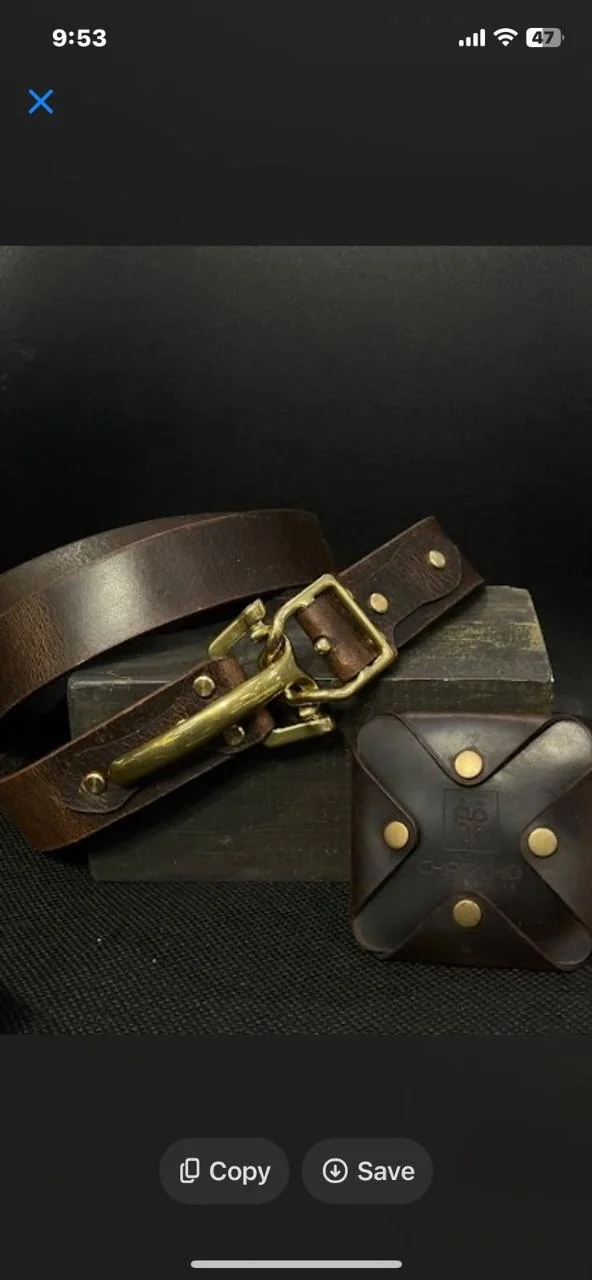
Belt size is measured precisely this way: take their old belt and measure from the end of the buckle to the hole they actually use. Send us that number and we will add the holes.
Personalisation
Initials are a good detail, but a gift adds two constraints: spelling and timing. Stamping takes two to three days, so do not leave it to the last morning. If the gift is a surprise, choose it without stamping — that keeps an exchange possible.
Wrapping and the card
A box, a cotton pouch, and a care card in three lines: damp, sun, rest. Those three sentences add years to a piece. Add two lines in your own handwriting — in a leather gift, that is what stays, not the box.
See also
-
What size bag suits everyday use
Bags are often chosen for how they look in a photograph. Later it turns out the water bottle does not fit, or the opposite — half the space stays empty and the bag swings against your hip.
Size follows from contents. Three simple steps are enough to get it right.
Contents first, size second
Lay out on a table everything you carry to work or into town: wallet, phone, keys, papers, a water bottle, tissues. If a laptop comes with you, add it.
Look at the pile and picture the box that would hold all of it in a single layer. The bag should be slightly larger than that box, not twice as large. Extra volume collects things at the bottom, makes them harder to find, and takes the shape out of the bag.
Three sizes and what fits
Small — phone, wallet, keys, lipstick, a compact umbrella. Good for an evening or a short errand; for daily use it is usually not enough.
Medium — this is the size that works most often. A 13-inch laptop, a notebook and a water bottle fit, with room left over. For town, work and travel.
Large — laptop, gym clothes, children's things, shopping. But the larger the bag, the more goes into it, and the heavier the shoulder becomes.
What matters more than size
Handle length. In winter a long handle over a coat is awkward; too short a handle means carrying the bag in your hand. If in doubt, choose an adjustable or detachable one.
How it opens. A zip is calmer in a crowd and in rain; an open top is quicker to reach into. In Batumi an open bag is pleasant in summer and less so in autumn.
The width of the base. A narrow base will not let the bag stand on its own — it always needs something to lean against. A wide base holds its shape but weighs a little more.
An inside pocket. One open compartment means hunting for your phone every time it rings. Two small pockets settle that.
Choosing one with us
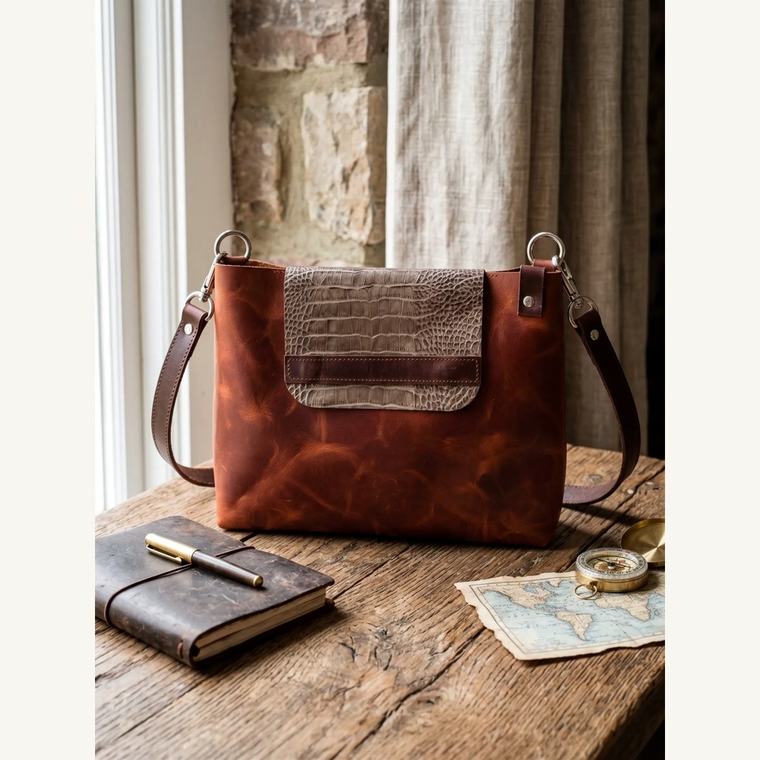
The cognac leather bag is a medium — the size described above. Handle length is set at the time of order, because it depends on the height of the person carrying it.
If you are still unsure, tell us what you carry each day. We will suggest a size and, where it helps, add the inside pockets.
See also
-
Why a handmade bag is worth it
The price of a handmade bag almost always raises the same question. Fair enough: from the outside two bags look alike, while the prices sit far apart.
This is not an attempt to argue that our bags are cheap. They are not. It is an explanation of what the price contains, and of when a handmade bag is not the right purchase.
What the price is made of
Three parts: material, labour, and the preparation that never appears as a line on an invoice — samples, drawings, failed attempts, tools.
A factory lowers the price through scale: a thousand identical parts come out of a press in one pass. A workshop has no scale — one object, one maker, one cutting. That is why comparing two outwardly identical bags often means comparing two different objects.
The material
Natural leather is not uniform. The difference begins with the layer: the top layer is whole and gains a patina over the years, while the lower layer is often bonded and carries a surface coating that goes at the first scratch.
We choose leather that becomes better looking with age rather than more worn. That choice costs more, and it is what decides how the bag looks three years on.
Work that photographs do not show
An edge is finished in several coats: each one dries, gets sanded, and only then does the next go on. The seam is sewn by hand with two needles — the thread is pulled from both sides, so a single break does not unravel the whole line.
Lining, pockets, buckles and handle fittings are added on top of that. Almost none of it shows in a photograph, which is why we ask people to look inside the bag and at the edge up close.
Lifespan and repair
A handmade bag lasts because it can be repaired. A seam can be re-sewn, a handle replaced, a buckle swapped, a lining renewed. A cheap bag is often glued, and that kind of repair is either impossible or costs more than the bag.
So the useful comparison is not price against price but price against the years the object is carried. That sum often tells a different story.
The cognac leather bag is built this way: hand-stitched, with a finished edge and a handle that can be replaced later.
When handmade is not worth it
If you carry a bag a few times a year, if you need several identical pieces of the same model, or if price is the only criterion, a factory bag is an honest choice. We do not see that as a problem.
Handmade pays off when one bag is carried every day, when you want it to follow your habits, and when paying a little more does not put you out.
See also
-
Handmade vs factory leather goods
The argument usually runs to one of two extremes: handmade lasts forever, factory goods last a season. Neither is quite true.
The real difference lies in how the work is organised — how the leather is cut, who stitches it, and how much time goes into the details. That is what decides how long a piece will last.
Where the difference starts
Cutting. In a factory a press cuts the leather: the same shape a thousand times, often before anyone looks at the direction of the grain. A maker cuts by hand and watches where the fibre runs, where a scratch or a stretched patch sits. Handmade parts therefore differ by a millimetre — that is normal, not a defect.
Stitching. A machine seam is fast and even, and it can be perfectly strong if the thread and stitch length are chosen well. The machine is not the problem; the time a factory allows for one seam is.
Details. This is where a piece loses or gains its value: reinforced corners, finished edges, how the handles are anchored, the shape of an inside pocket. These are the places that wear first, and the ones least visible in a photograph.
When factory is the better choice
If you need two identical pieces, if budget decides, if the item is needed for a few months, or if it is for a child — the factory option is logical and honest. We see nothing wrong with it, and no offence is taken when someone chooses otherwise.
Our position
We are not saying factory goods are bad. We are saying we do something else: small batches, where one maker assembles a piece from start to finish; construction that can be repaired; and the chance to fit the size, the handle length or the inside pockets to one particular person.
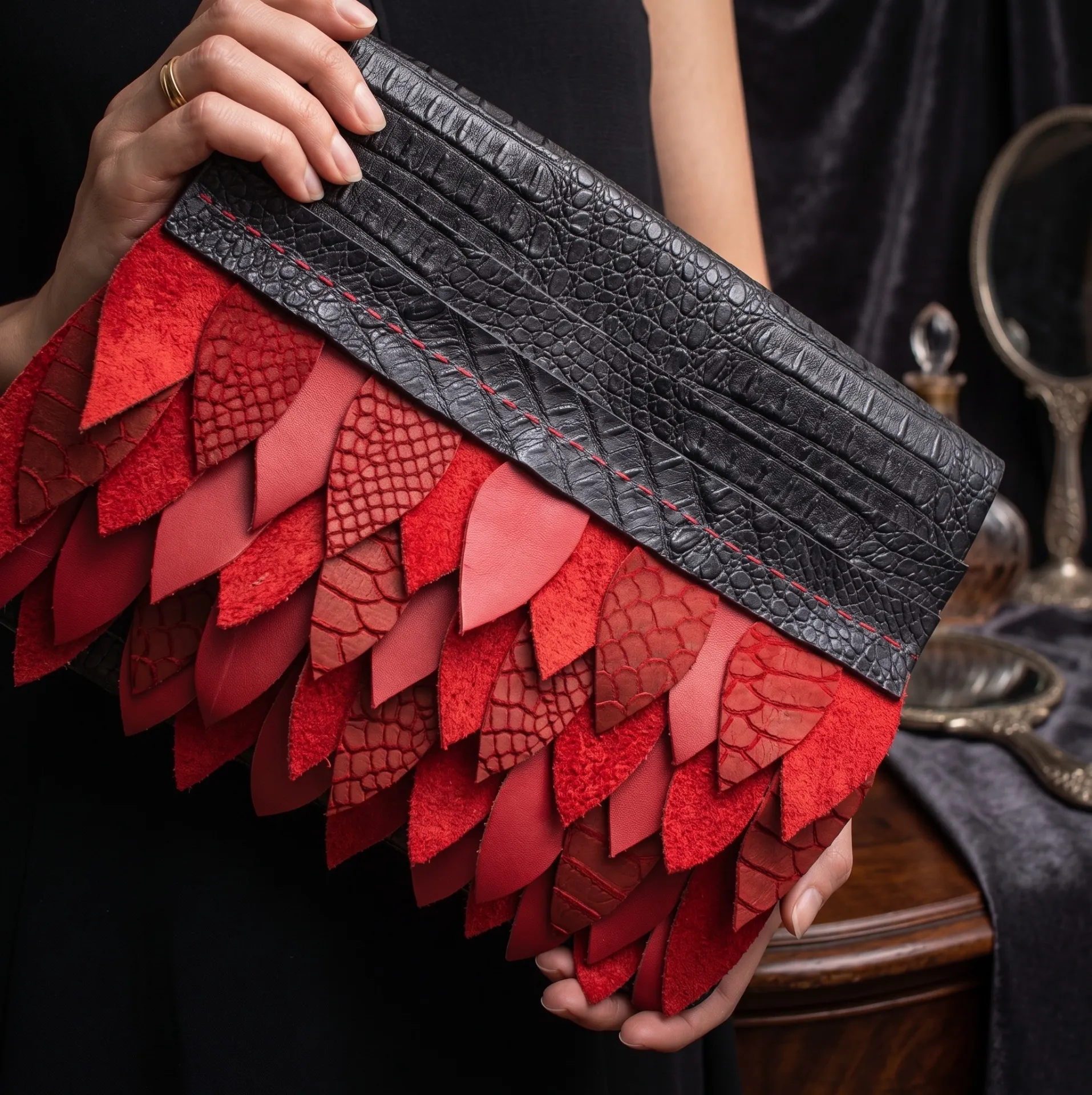
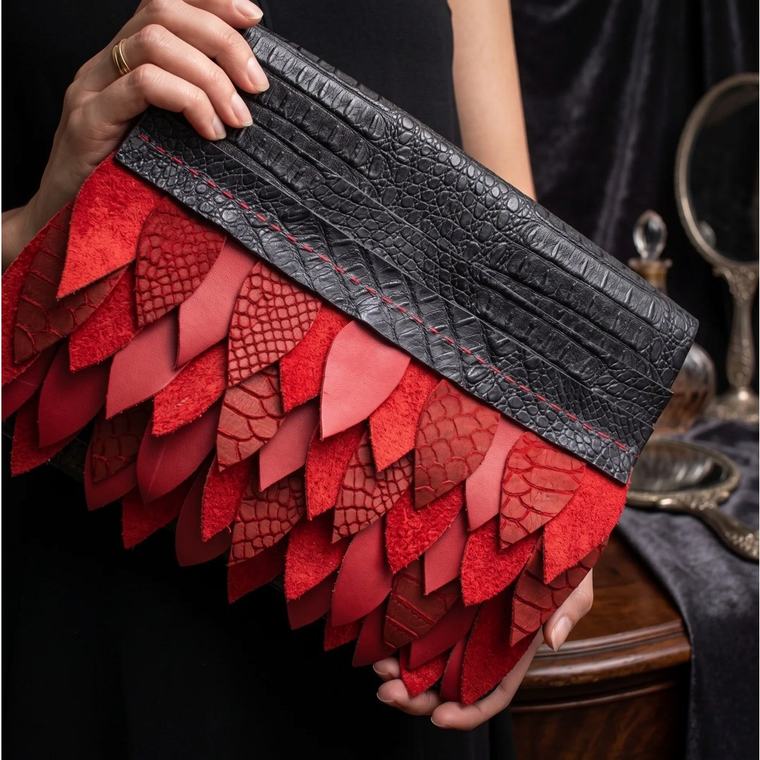
The clutch in textured red and black leather is a fair example of what we mean: two leathers, a seam run by hand, and an edge finished so that even up close you can see how it is put together.
See also
-
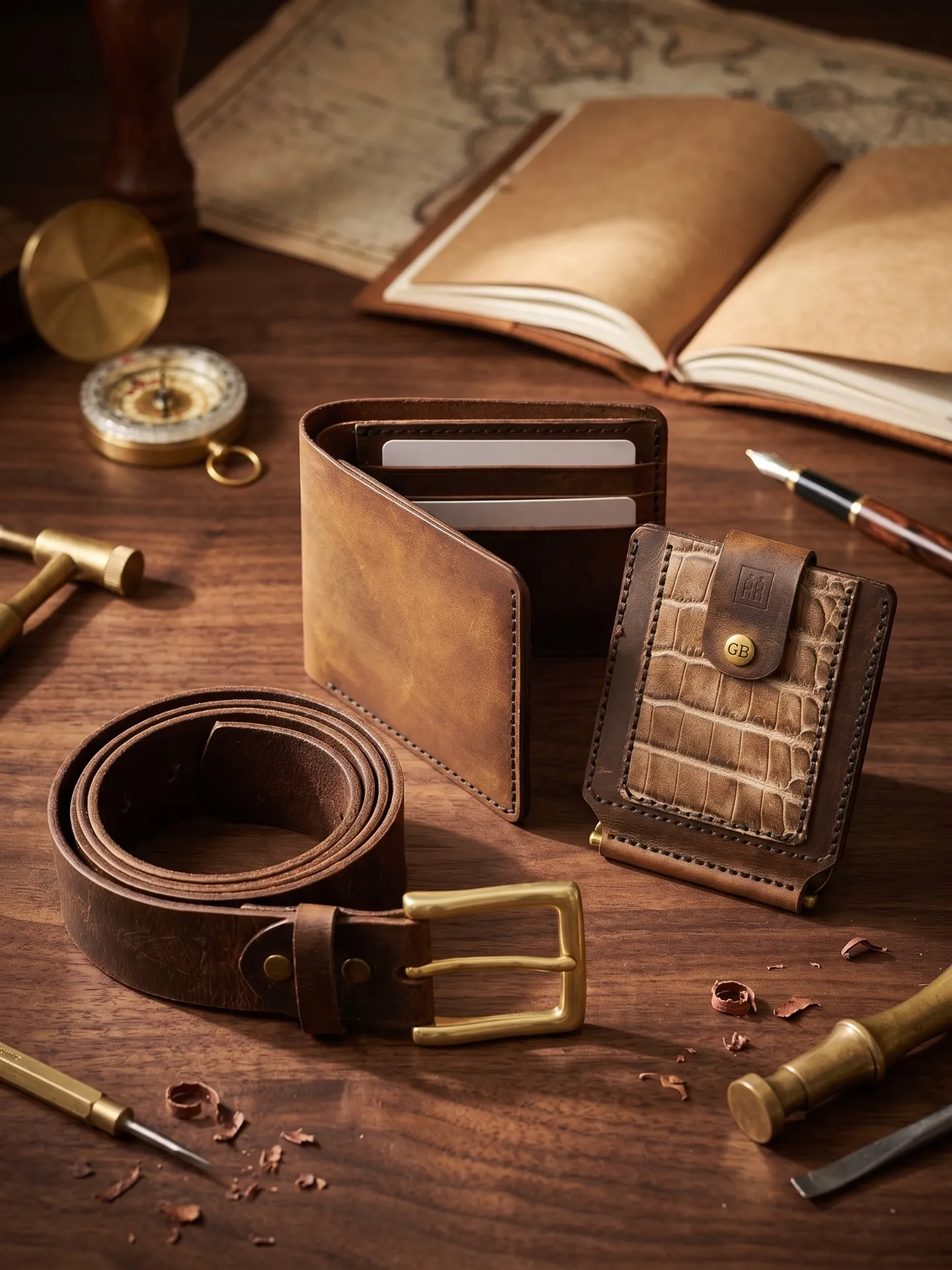
Cleaning a leather bag: salt, rain, stains
In Batumi, Sakartvelo, a leather bag has two steady opponents: salt from the sea air and frequent rain. The rest — coffee, a door handle, juice spilled on the way — is detail. Natural leather takes a lot, but not indifference. A stain left alone for two days settles into the fibre, and after that only re-toning helps.
Salt: the white line that settles deep
Salt pulls moisture towards itself. Before the crystals work into the fibre, a soft, slightly damp cloth and a light stroke from the edge of the mark towards its centre is enough. You do not need pressure; pressure darkens leather. Then let the bag dry at room temperature, away from a radiator or a hairdryer.
If the white ring has already dried, wet the cloth in slightly warm water, repeat the same strokes, and finish by lifting the moisture with a dry part of the cloth. Leather often stays dry after salt, so a colourless leather conditioner is not wasted here.
Rain: the drying does the damage
Wet leather does not spoil by itself. Fast drying does: hot air, a hairdryer, a heater. The surface layer shrinks at once while moisture stays inside, and the result is stiffness and uneven colour.
Open the wet bag, put clean paper or cloth inside so it keeps its shape, and leave it in the shade. Straighten the handles so no permanent fold forms in one place.
Grease, coffee, water
With a grease stain the first step is absorption, not rubbing: a dry paper napkin, light pressure on top, then leave it alone. You can sprinkle cornflour or talc over the spot and leave it for two or three hours; the powder draws out the excess oil.
Coffee and wine are water-based marks: a clean, slightly damp cloth, strokes from the edge inwards, a fresh part of the cloth on every pass. Do not scrub. A scrubbed patch loses its sheen and shows clearly in daylight.
What not to do
Soap, washing powder, alcohol, acetone and household cleaners strip wax and dye from the surface layer. A rough sponge or brush leaves scratches. A damp bag never goes into a cupboard or a plastic bag, where mould has its best conditions.
If a stain is old and sits on the surface like a crust, use a colourless leather cleaner made for the job and follow the maker's instructions. Home experiments on old stains usually cost you the colour.
When it needs a craftsman
If the leather has gone stiff, the colour has worn unevenly, or the stain is no longer on the surface but inside it, household remedies will not reach it. That is the point to bring the piece to us: re-toning and feeding are done in separate steps, and sometimes the stitching needs refreshing too.
See also
-
Scratches on leather: what can be done
A scratch on leather means the piece is being used. One disappears in three minutes, another stays and slowly turns into patina — which is exactly what many people love about natural leather. The important thing is to know which kind you are looking at before you try anything.
Three types, three different answers
- Surface: only the wax or the top finish is touched. Run a finger over it and you feel nothing.
- Deep: the top layer is cut through, and a lighter inner layer shows.
- A cut: it has edges, with the leather slightly raised around them.
The same bag usually carries all three at once, so deal with the deepest first and the surface ones after. If you are unsure, look at the scratch from the side, towards the light. A surface mark only shows from above; a deep one casts a shadow.
A surface scratch: warmth and wax
The most common case and the easiest. Rub the scratch in small circles with a clean finger. Body warmth softens the wax just enough and the line closes. Often that is all it takes.
If it does not close, take a colourless leather wax or balm, a small amount on a soft cloth, and use the same circular motion. Wipe off the excess with a tissue and give it an hour; the leather will spread what is left on its own.
A deep scratch: restoring colour
Here you need colour. Choose a leather dye matched exactly to the piece. Slightly lighter is better than darker, because dark reads as a stain. Apply it with a cotton bud on the scratch only, almost dry, and let it set.
Repeat in two or three thin layers, a few minutes apart. A colourless wax at the end blends the whole surface. Before you touch a visible area, test inside, under a seam, where a mistake goes unnoticed. If you cannot match the tone, leave the scratch a shade light: leather darkens over time and the difference softens.
When a home attempt does harm
Do not touch a scratch that has become a cut with raised edges; ordinary cream makes it more obvious. Nor when the leather has thinned or a seam has opened: that is repair, not cosmetics. Suede and nubuck are toned differently, and those pieces are better shown to a craftsman.
Prevention in daily wear
Most scratches come from inside the bag: keys, a glasses case, sharp edges. A small inner pouch or a soft divider solves it. On a belt, scratches come from the buckle, so the buckle belongs at the end of the strap, not at the side. And wax now and then: fed leather takes a scratch far more slowly than dried-out leather. In a humid city like Batumi, in Sakartvelo, that matters more, because leather left damp takes a scratch deeper.
See also

Have an idea? We will make it.
Write or call us - together we will choose the material, colour and size, and make the piece to order.