 Free Delivery in Batumi


Blog
From the workshop: materials, care, gifts and the stories behind the pieces.
-
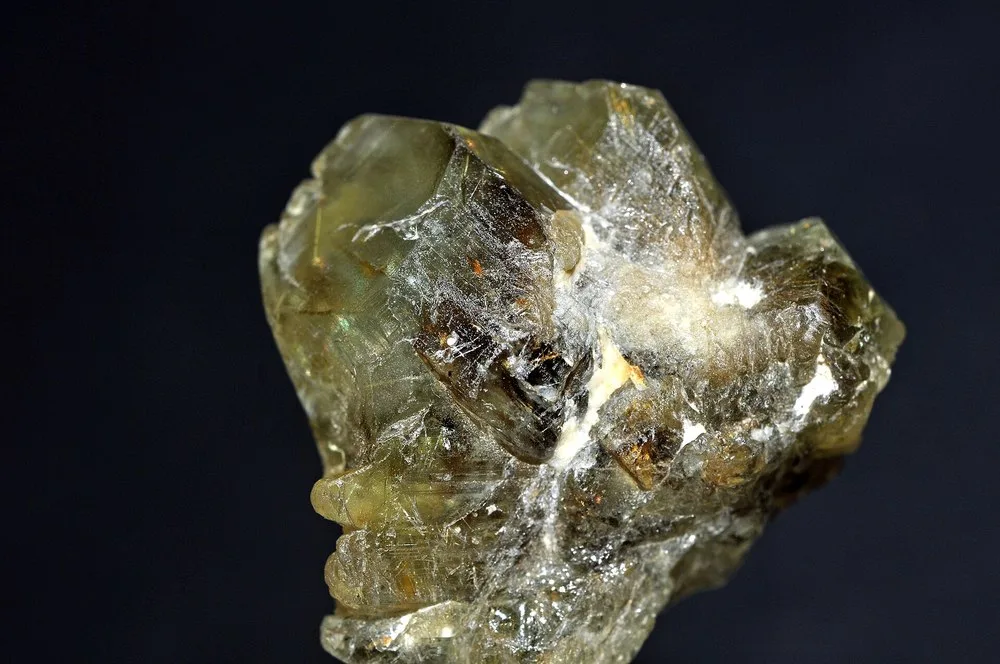
Chrysoberyl
Chemical formula – BeAl₂O₄
Hardness – 8.5
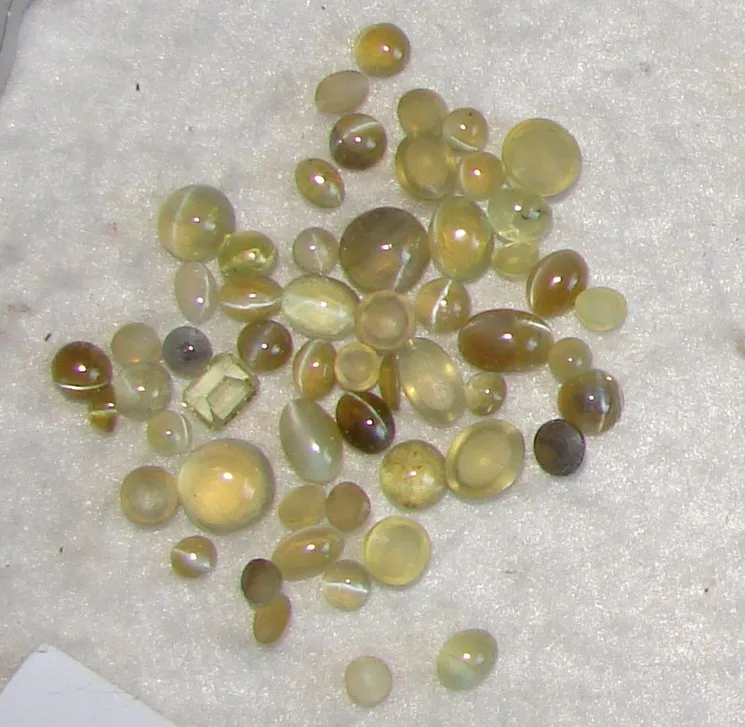
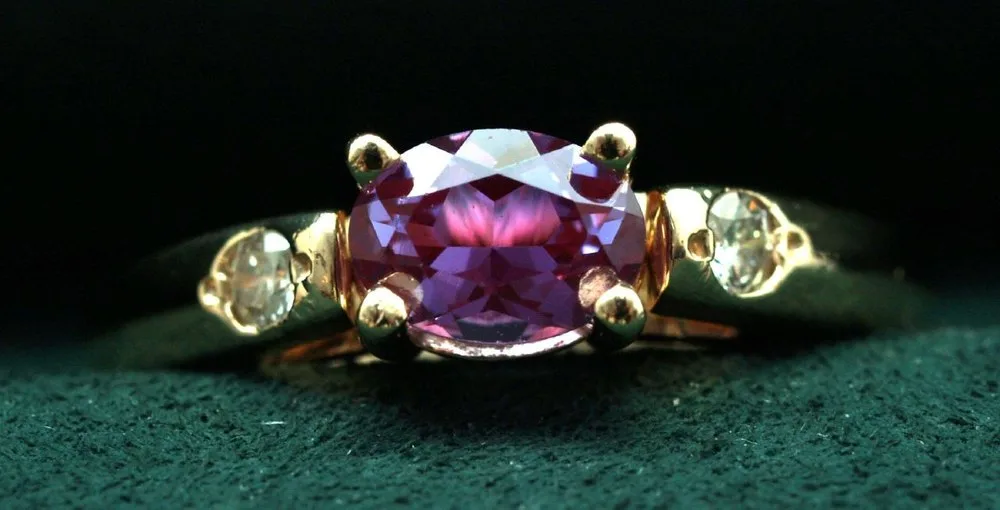
Colour – yellowish, greenish, oliveChrysoberyl is a compound of beryllium, aluminium and oxygen. Despite the name it does not belong to the beryl family — aquamarine and emerald are different minerals. Chrysoberyl forms a group of its own, with three faces: the ordinary yellow-green stone, cymophane with its cat's-eye effect, and the colour-changing alexandrite.
The name is Greek: "chrysos" for gold, "beryllos" for beryl. The stone was first described in 1789 but was long confused with peridot, since both are yellow-green and only hardness and composition separate them.
Prices are sharply divided: ordinary chrysoberyl is relatively affordable, a stone with a good cat's-eye costs more, and alexandrite costs more than diamond. That is why synthetic cat's-eye is often sold on the market under the chrysoberyl name.
Origins
Chrysoberyl is rare and its deposits are few. The main suppliers are Brazil, Sri Lanka, India, Tanzania, Madagascar and Russia. Sri Lanka is especially known for fine cat's-eye material.
Properties
Tradition treats chrysoberyl as a stone that brings luck. It is said to add joy, love, energy and generosity to life.
Esoteric writers also call it an emotional healer: chrysoberyl, they say, wakes creativity and nobility in a person. On the whole it is counted as a strong protector — especially when someone is under pressure from their surroundings or from unfair criticism.
Traditional healing properties
Lithotherapists use chrysoberyl for problems with the kidneys, the pancreas and the liver, and for poor circulation.
This describes traditional practice, not medical advice. A stone does not replace a doctor.
Chakras
Chrysoberyl is linked to the third, solar plexus chakra – manipura, and the seventh, crown chakra – sahasrara. The cat's-eye variety is also tied to the sixth, brow chakra – ajna.
Zodiac
Tradition gives chrysoberyl to Leo, the sign of the sun, whose warmth matches the stone's golden tone. It also suits Scorpio and Virgo, whose character fits its precision.
In Charcho jewellery
Thanks to its hardness chrysoberyl is ideal for a ring: 8.5 means daily wear does no harm. We have no ready-made piece in the catalogue yet, but we make them to order; a small faceted stone works well in a ring or a pair of earrings. Catalogue: rings, earrings.
Real or fake
- The usual imitation of cat's-eye is optical fibre glass. In a natural stone the bright band moves softly and bends near the edges; in glass it is too straight and too sharp.
- Synthetic alexandrite is everywhere. Natural stone changes colour with the light — green-blue by day, red under a lamp — while synthetic often looks "too" clean in colour.
- Chrysoberyl is often sold as a doublet or triplet: the top layer is real, the bottom is another mineral. Such a composite shows a straight horizontal line under a loupe.
- Natural chrysoberyl is much heavier than glass of the same size and feels cold in the hand.
Care
Hardness 8.5 leaves the stone almost untouched by daily wear. Warm water, mild soap and a soft cloth are enough. Steam and ultrasonic cleaning are usually safe when the stone is free of cracks; a cracked piece should only be cleaned by hand.
See also
-
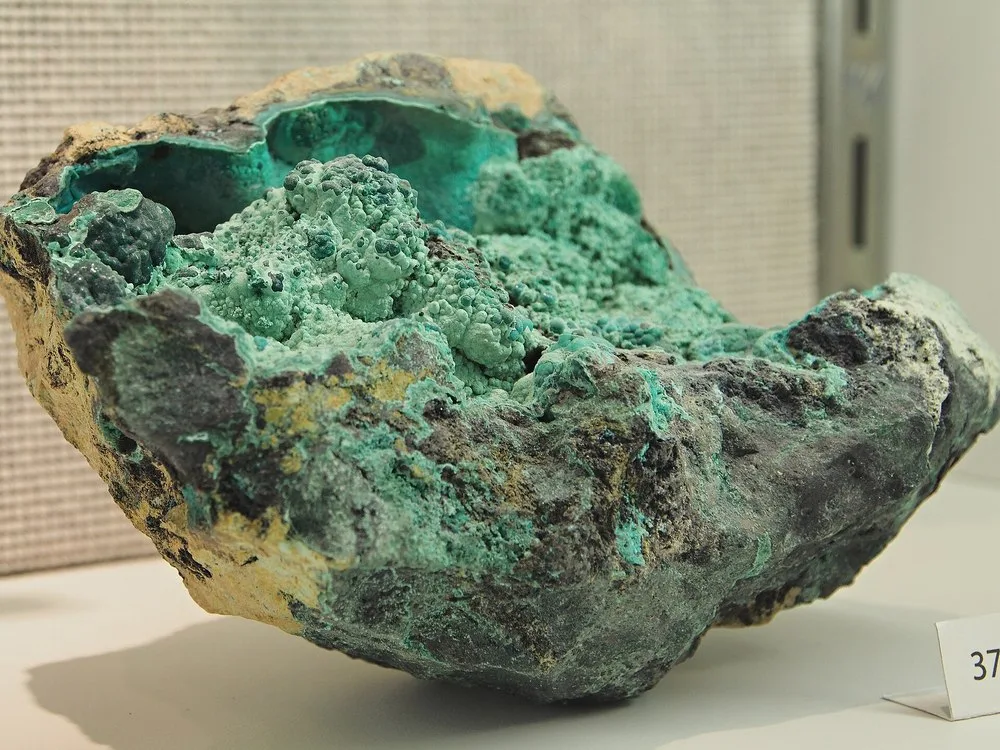
Chrysocolla
Chemical formula – (Cu,Al)₂H₂Si₂O₅(OH)₄·nH₂O
Hardness – 2–4
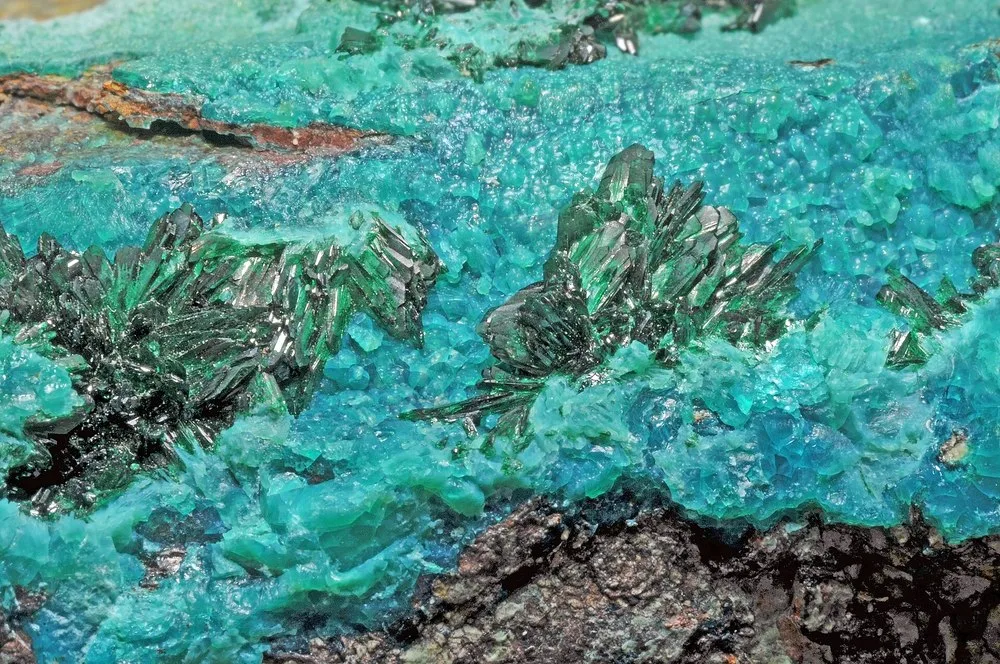
Colour – green, blue, sky blueChrysocolla is a hydrated copper silicate. It forms where copper ore is weathering, and it takes its colour from the copper: from deep sky blue to olive green. Pure material is uncommon; most of it grows intergrown with malachite, azurite, turquoise or quartz, which is why a single piece often shows several colours and wavy bands at once.
The name is Greek: chrysos for gold, kolla for glue. In antiquity it referred to the mineral used as a flux when soldering gold. Later the name settled on this blue-green stone.
Price follows purity. A solid, even blue cabochon is rare and expensive; what you mostly see on the market is chrysocolla in quartz — harder, better suited to jewellery and considerably cheaper.
Origins
Israel, Chile, England, Mexico, Peru, Russia and the USA are the main sources. Arizona and Congo are known too. Stone from the Timna Valley in Israel has been prized since ancient times.
Properties
Tradition calls chrysocolla the stone of harmony. Its energy is described as gentle, and it is used to clear a room or a person's aura. It is said to calm fear and anger, and practitioners reach for it during panic attacks. Some say it helps with phobias such as claustrophobia and agoraphobia.
Traditional healing properties
Lithotherapists use chrysocolla for asthma, inflamed lungs, arthritis, various pains, gland problems and spasms.
This describes traditional practice, not medical advice. A stone does not replace a doctor.
Chakras
Chrysocolla is linked to the heart and throat chakras – anahata and vishuddha.
Zodiac
Tradition pairs chrysocolla with Taurus and Sagittarius. It gives Taurus a little more of the calm it already values, and helps Sagittarius keep calm inside a loud life.
In Charcho jewellery
We do not have a ready-made piece in the catalogue yet, but we make them to order — you choose the shape and size of the stone. Catalogue: necklaces.
Real or fake
- Much of what sells as chrysocolla is dyed quartz or agate. Real chrysocolla has a hardness of 2–4, so even a fingernail leaves a mark.
- In natural stone the colour sits in patches and waves. A completely even, bright blue should make you suspicious.
- Some soft material is impregnated with resin so it survives in a setting. That is normal practice, but the seller should say so.
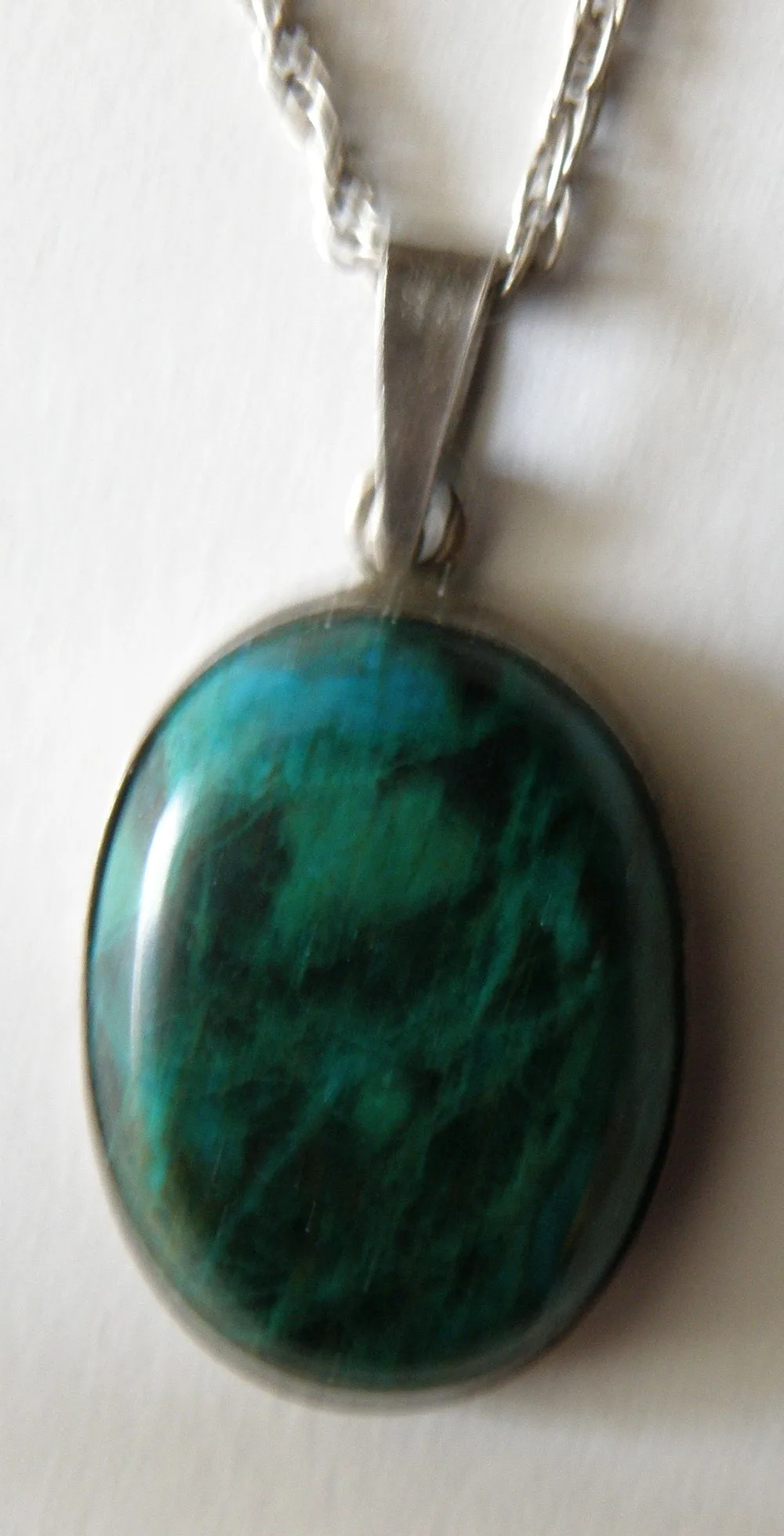
- "Eilat stone" is a natural mix of chrysocolla, turquoise and malachite, not a mineral in its own right.
Care
Hardness 2–4 means the stone is soft and will not survive daily wear in a ring. No soaking, no ultrasonic, no steam; a dry or slightly damp soft cloth is enough. Acids and household cleaners damage it, so store it apart from harder stones.
See also
-
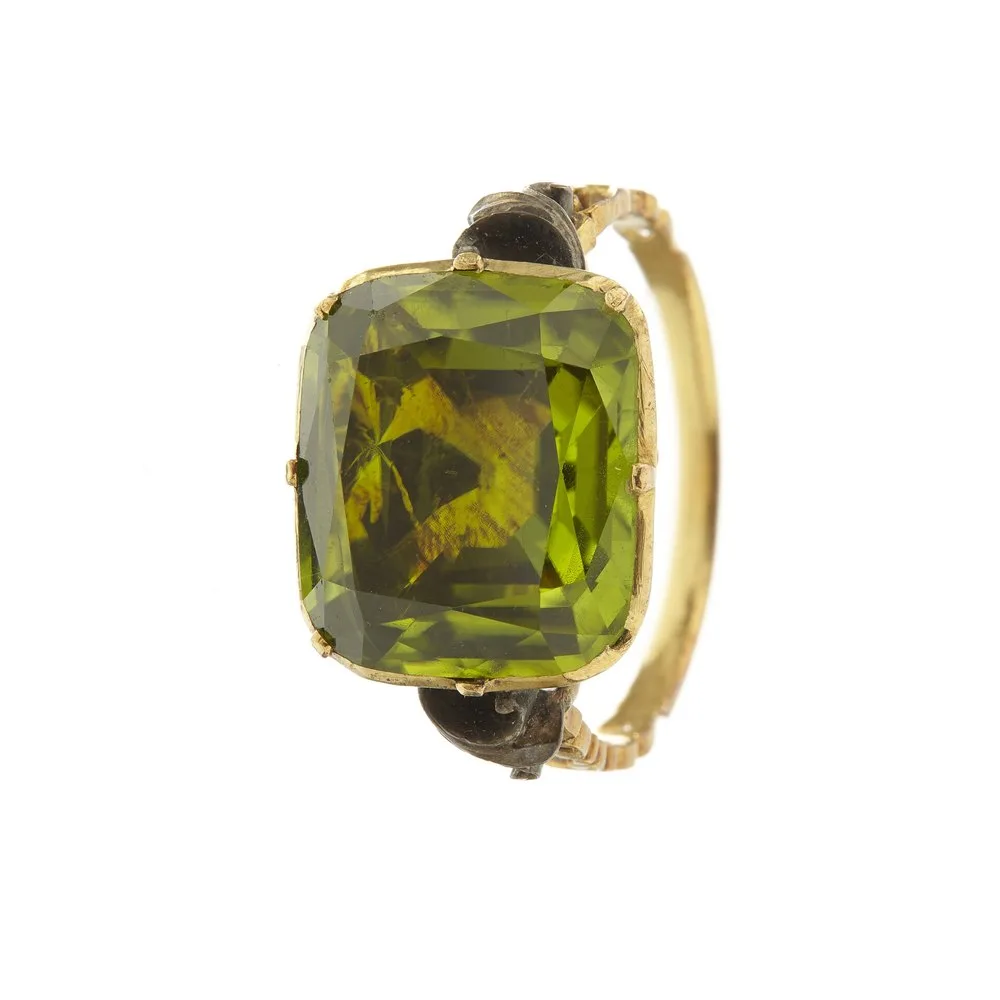
Chrysolite (Peridot)
Chemical formula – (Mg,Fe)₂SiO₄
Hardness – 6.5–7
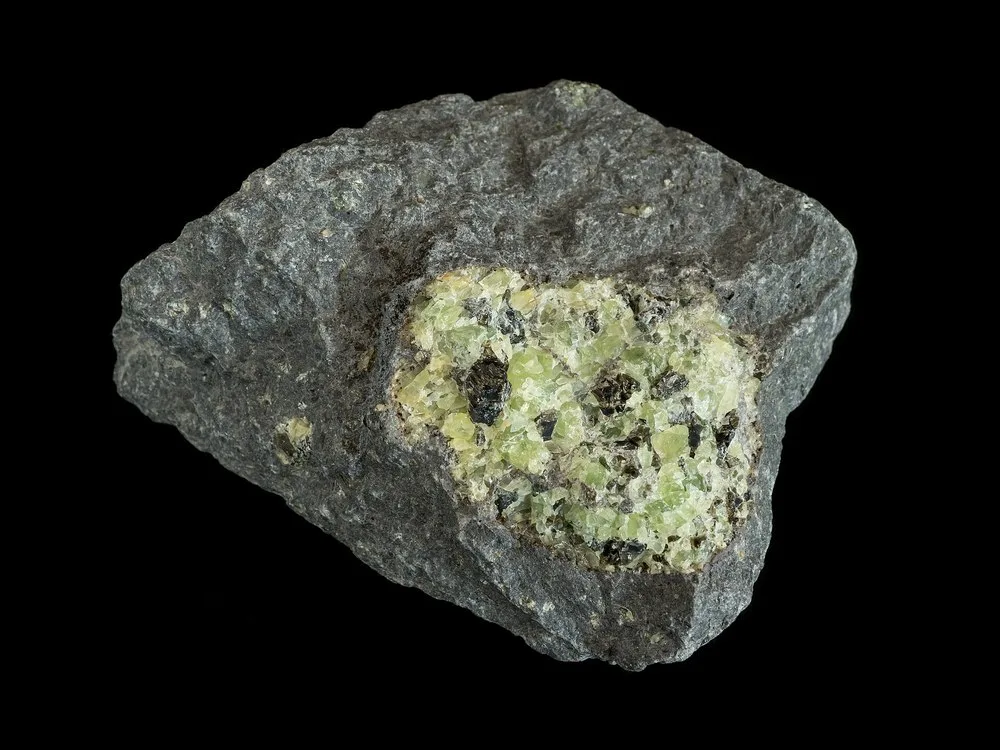
Colour – green, yellowishChrysolite is the gem-quality green variety of the mineral olivine, and plenty of people simply call it olivine. It forms in the Earth's mantle and rides to the surface inside basaltic lava. What makes it unusual is that it belongs to the small group of minerals found in nature in only one colour family: from pale yellow-green through to a dark brownish green.
The name comes from Greek — chrysos for gold, lithos for stone. The old workings were on a single island in the Red Sea, and traders called the stone the evening emerald, because its colour held even in poor light.
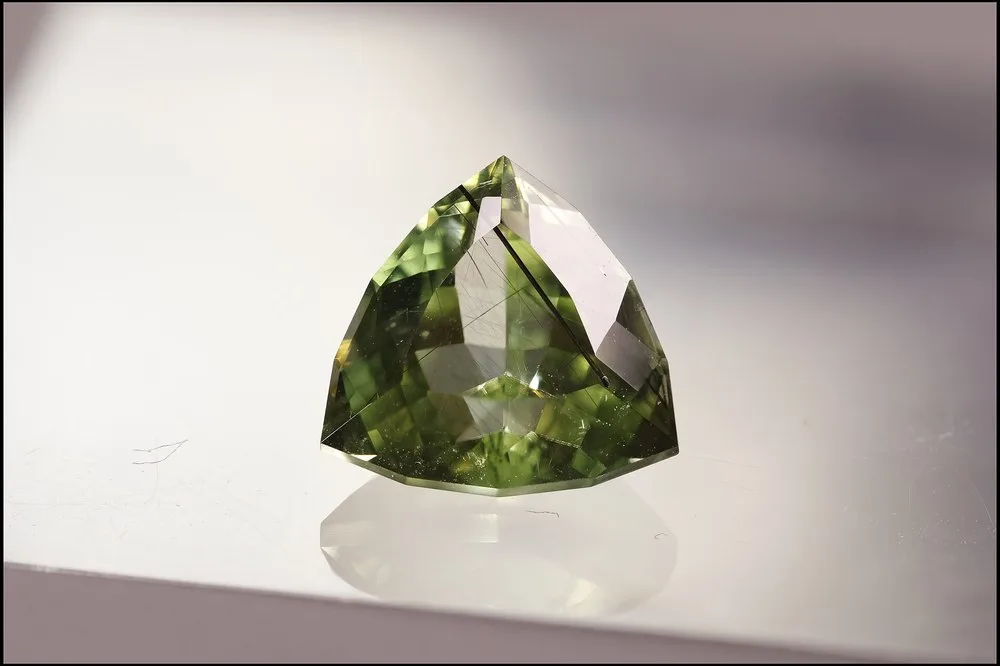
Price is set by colour and clarity. A clean, bright green or olive stone costs the most; brownish and hazy pieces cost little. Large peridot without cracks is scarce on the jewellery market.
Origins
Pakistan is the biggest supplier today. The stone also comes from Australia, Brazil, China, Mexico, Norway, Tanzania, Myanmar and the USA. A large deposit was found in China recently, so prices may shift over time.
Properties
Peridot is tied to the sun, which is why ancient civilisations valued it and used it to ward off evil forces. Esoteric writers use it to smooth life cycles, linking it to mental and emotional phases and to intellectual growth.
Its energy is described as friendly, and it is said to bring abundance and income. Tradition holds that it is a good stone for strengthening relationships and making new friends.
Traditional healing properties
Lithotherapists use peridot to release stress, anger, hatred, jealousy and envy. Healers also apply it to endocrine problems and say it supports the digestive system.
This describes traditional practice, not medical advice. A stone does not replace a doctor.
Chakras
Chrysolite is linked to the heart and solar plexus chakras – anahata and manipura.
Zodiac
Tradition ties chrysolite to Leo and Virgo — it is counted as a stone of late summer. Because of its solar nature it also suits Aries.
In Charcho jewellery
We do not have a ready-made piece in the catalogue yet, but we make them to order — you choose the bead size and shade. Catalogue: necklaces.
Real or fake
- The most common imitation is dyed quartz. Dye pools in the cracks, so under a loupe you will see darker lines running along them.
- Natural peridot carries characteristic inclusions, oval or shaped like a lily pad. A perfectly clean stone at a low price is a warning sign.
- Peridot has strong double refraction: under a loupe the back facets look doubled.
- Glass and plastic feel warmer to the touch and are noticeably lighter.
Care
Hardness 6.5–7 lets you wear it daily, but the stone handles knocks and sudden temperature changes badly. It needs no ultrasonic or steam; warm water, mild soap and a soft cloth are enough. Keep it away from perfume, hairspray and acids, and store it separately from other jewellery.
See also
-
Chalcedony
Chemical formula – SiO₂
Hardness – 7
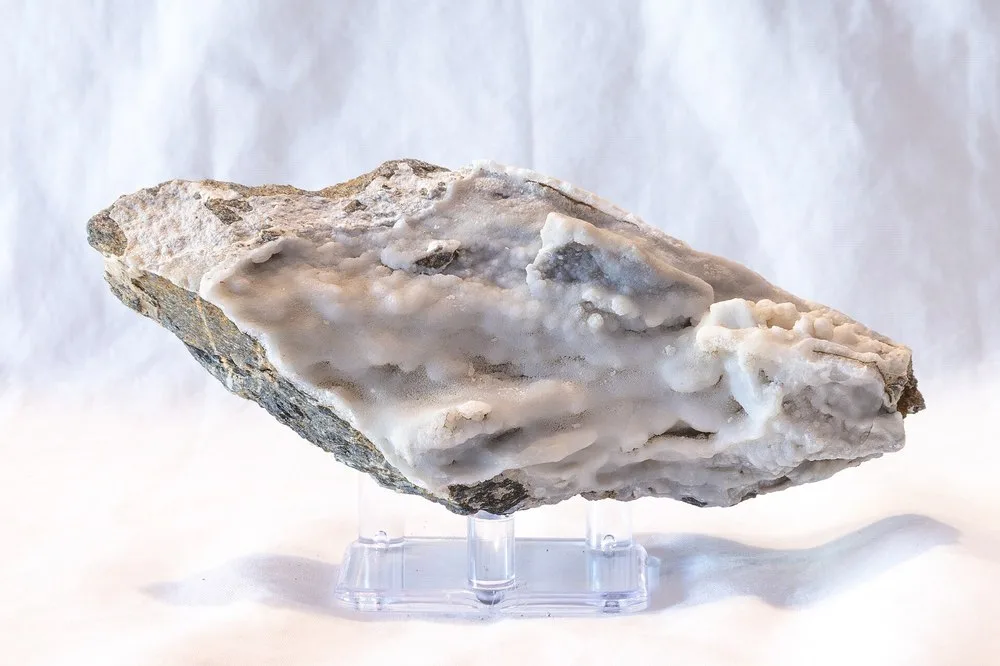
Colour – grey, white, bluish, lilac, yellow, brownChalcedony is a mineral of the quartz family, but not a crystalline one: its grains are so fine that no single crystal can be seen, even under a lens. That is where the waxy lustre comes from, and the soft, milky way it passes light — something ordinary quartz never does.
Technically "chalcedony" is a gemmological term covering a whole family: agate, onyx, carnelian, chrysoprase, bloodstone and blue chalcedony. The pure mineral itself is white or grey; every other colour comes from impurities.
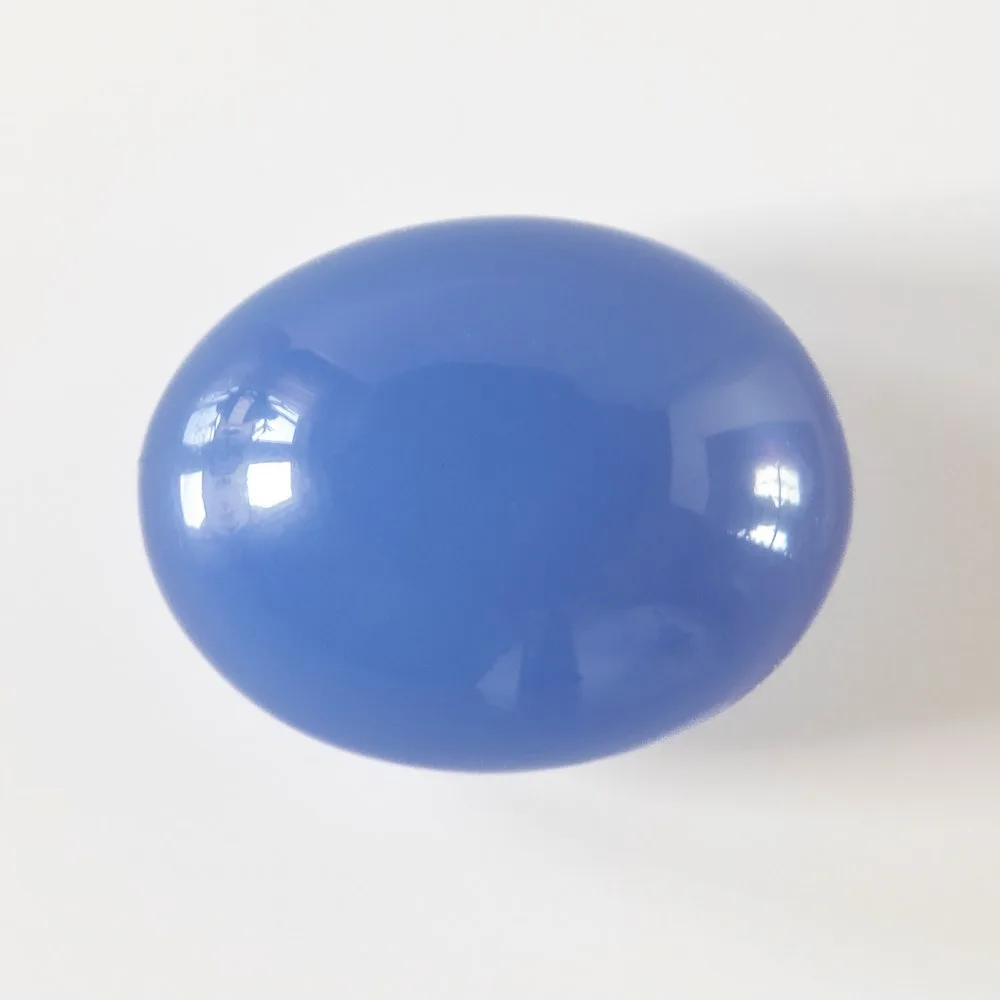
The name goes back to the ancient city of Chalcedon on the Bosphorus, on the Asian side of modern Istanbul. Price is easy to read: white and grey chalcedony is cheap, natural blue costs more, and clean translucent blue pieces, often shipped from Anatolia, sit at the top.
Origins
Chalcedony forms in volcanic regions where hot, silica-rich water cools slowly inside cavities. The main deposits are in Uruguay, India, Madagascar, Mexico, Brazil, Africa and the United States. Turkey and Namibia are the classic sources of blue chalcedony.
Properties
Esoteric writers treat blue chalcedony as a stone of gentle energy. It is said to calm an irritated person, release tension stored inside and make its owner more open.
Chalcedony is believed to loosen speech: a person becomes braver about starting a conversation and calmer about saying what they actually think. In ancient civilisations it was counted as a strong guard against the evil eye, and it was also used to clear bad dreams and the reasons behind them.
Traditional healing properties
In the past blue chalcedony was used to improve eyesight and for eye disease. Today lithotherapists mention it for circulation, bones, the spleen and the gallbladder.
This describes traditional practice, not medical advice. A stone does not replace a doctor.
Chakras
Chalcedony is linked to the fifth, throat chakra – vishuddha. Pink pieces are sometimes also tied to the fourth, heart chakra – anahata.
Zodiac
Tradition gives chalcedony to Cancer, a sign for which emotion and a warm home matter most. It also suits Sagittarius and Capricorn, whose character matches the stone's calm.
In Charcho jewellery
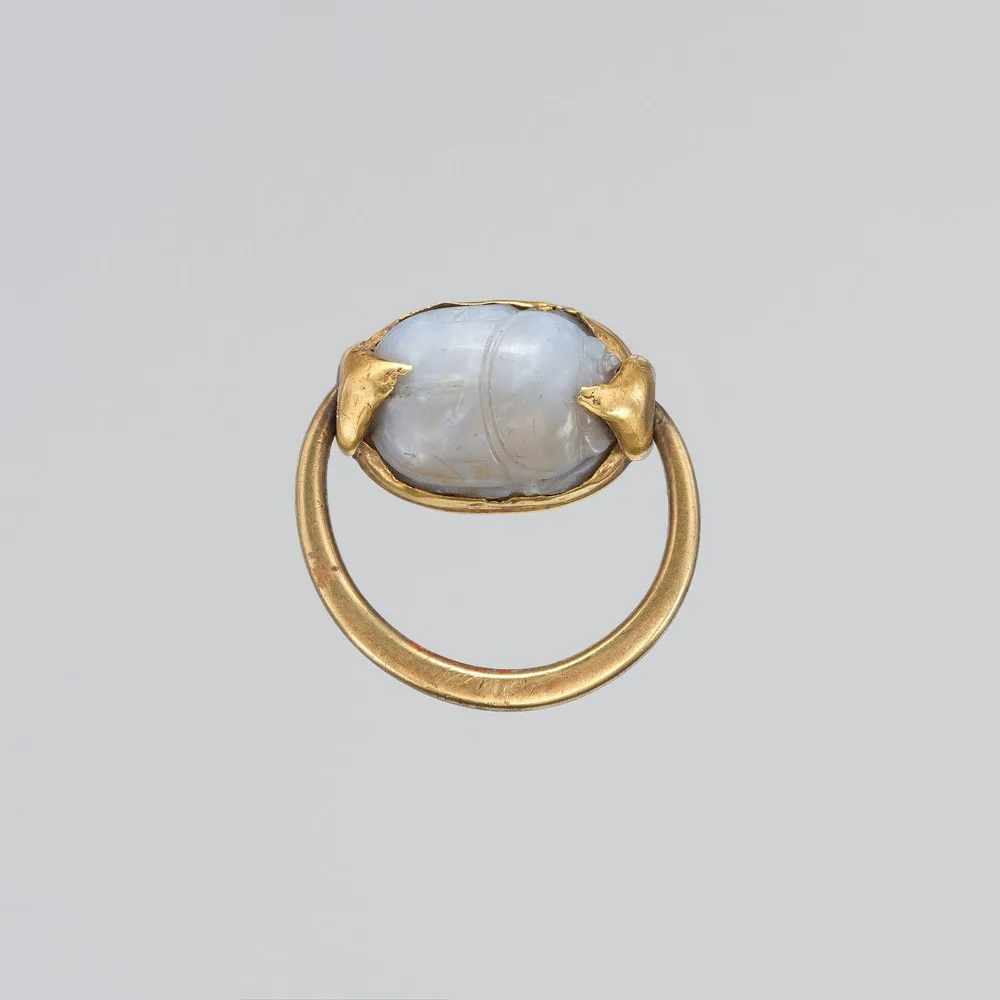
Chalcedony is most often cut into beads and cabochons — the waxy lustre shows best on a smooth surface. We have no ready-made piece in the catalogue yet, but we make them to order: you choose the colour and the bead size. Catalogue: necklaces, bracelets.
Real or fake
- Natural blue chalcedony is pale, a greyish blue. If a stone is "too" blue and the price is low, it has almost certainly been dyed.
- A sign of dyeing is colour pooled in cracks and tiny pores — up close you see darker lines.
- Glass and plastic scratch quickly and feel warm in the hand; chalcedony is cold and dense.
- Natural stone carries a slight cloudiness — perfect glass-like clarity is rare.
Care
Hardness 7 allows daily wear, but dyed pieces need gentle washing: hot water and detergents strip the colour. Warm water, mild soap and a soft cloth are enough. Ultrasonic cleaning is fine for natural chalcedony, not for dyed.
See also
-
Amber
Chemical formula – C₁₀H₁₆O
Hardness – 2–2.5
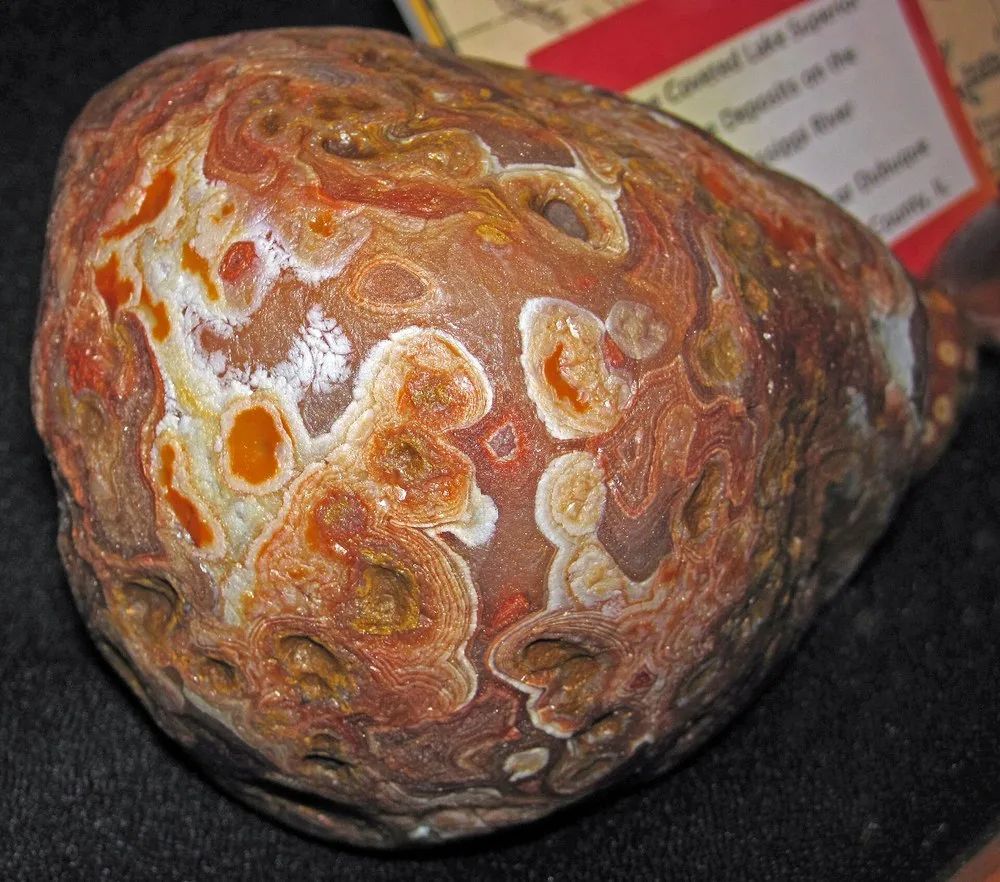
Colour – yellow, brown, carrot, redAmber appears on lists of minerals but it is no stone at all: it is fossilised tree resin. Tens of millions of years ago conifers bled resin, which cooled slowly, lost its air and hardened over time into warm, dense tones. That is why insects and leaves are often found sealed inside — "inclusions", the thing that makes amber most valuable.
Amber belongs to a small group of organic minerals, alongside pearl, coral, nacre and jet. Baltic amber, also called succinite, is roughly 40–50 million years old and supplies most of the world market.
Price rests on three things: transparency, colour and inclusions. Clear honey beads are affordable, bright "cherry" Baltic amber costs more, and a piece with a well-preserved insect can fetch ten times the price of a clean stone of the same size.
Origins
Russia is the largest supplier — the Kaliningrad region produces most of the world's amber. The Baltics come second: Lithuania, Latvia, Estonia and Poland. Amber is also mined in Italy, China, Japan, Mexico, Canada and the United States, while the Dominican Republic is known for rare blue amber.
Properties
Esoteric writers treat amber as an unusual stone because it calms and refills energy at the same time. It is said to wake a taste for learning and to make its owner more level-headed and patient.
Tradition credits amber with the energy of love, protection, patience and balance. In the past it was also counted as a stone of luck, bringing calm into a marriage.
Traditional healing properties
Amber has been used since ancient times to cleanse the body. It is regarded as one of the best stones for the thyroid. Lithotherapists say it eases pain and supports circulation, the kidneys, the heart, the lungs and the bones.
This describes traditional practice, not medical advice. A stone does not replace a doctor.
Chakras
Amber is linked to the third, solar plexus chakra – manipura, or to the second, sacral chakra – svadhisthana. The exception is blue amber from the Dominican Republic and Mexico, which is tied to the throat chakra – vishuddha.
Zodiac
Tradition gives amber to Leo, the sign of the sun, whose warmth matches the stone's own. It also suits Taurus and Aries, whose character fits amber's protective, earthy nature.
In Charcho jewellery
Amber is usually cut into beads — the warm colour shows best at the neck. There is no ready-made piece in the catalogue yet, but we make them to order. Because amber is so soft, we set it in an open frame. Catalogue: necklaces, bracelets.
Real or fake
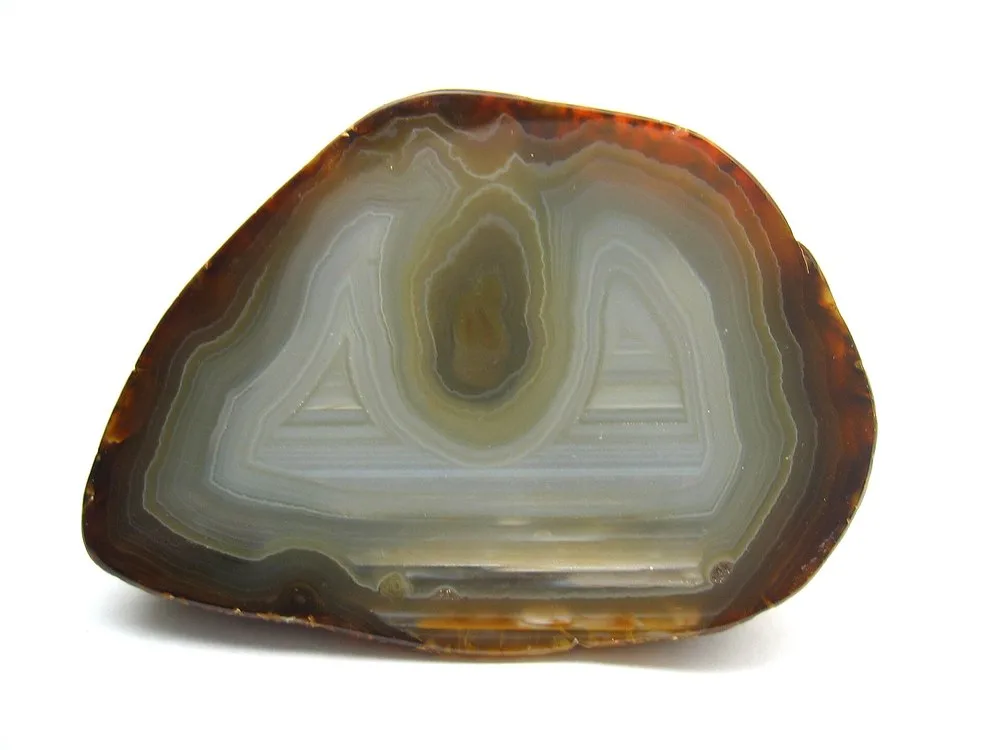
- The most common "fake" is copal, a much younger and softer resin. It feels tacky in the hand and alcohol damages it quickly.
- The saltwater test is simple: real amber floats in salted water, ordinary plastic and glass sink.
- Under ultraviolet light Baltic amber glows blue-green, while copal gives a duller, whiter response.
- The hot needle test smells of resin on real amber and of chemicals on plastic, but it damages the piece — leave it to an expert.
Care
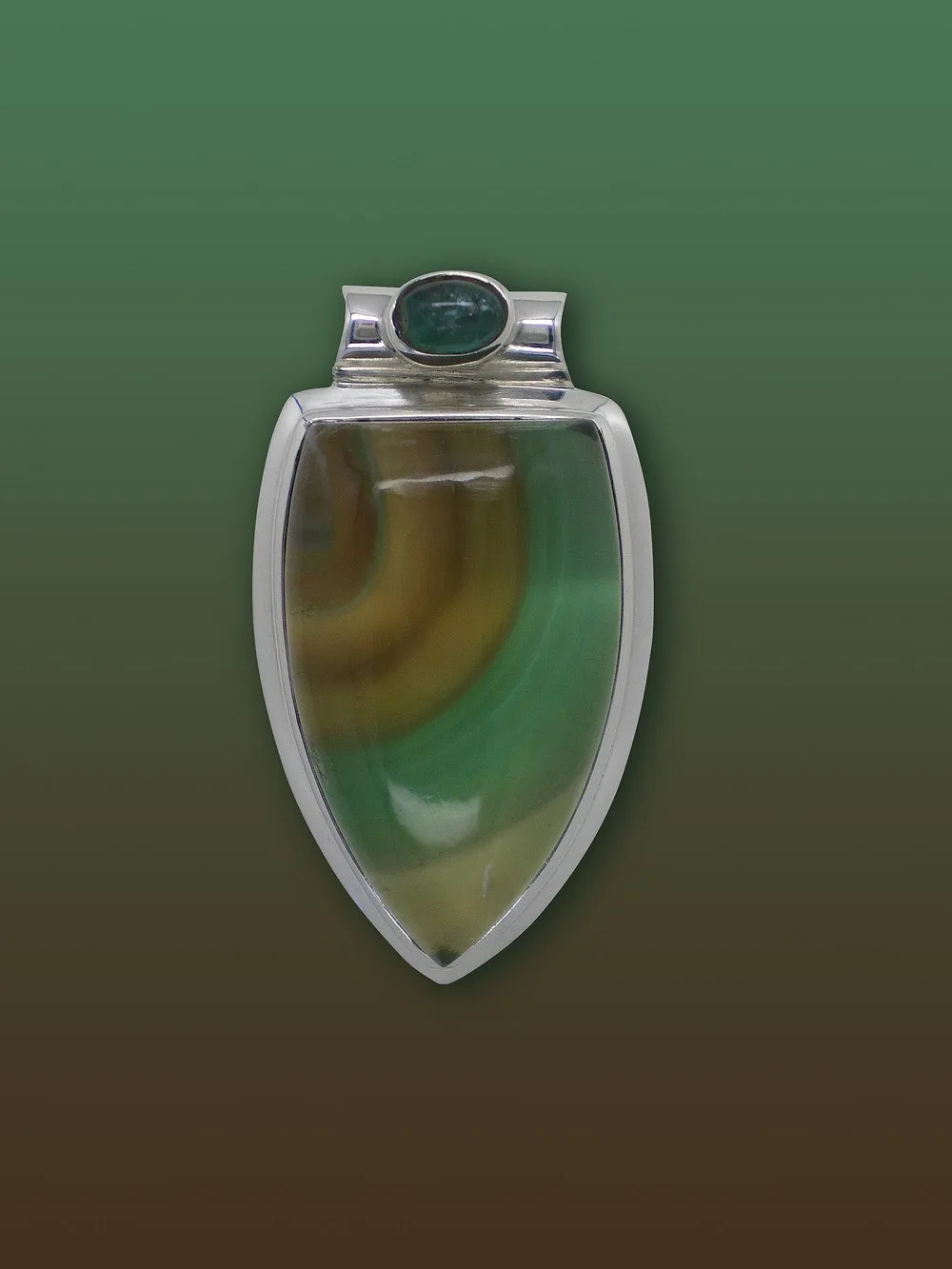
Hardness 2–2.5 puts amber among the most delicate stones. Never use alcohol, acetone or perfume: they dissolve the surface. Keep it away from ultrasonic cleaners, steam, hot water and direct sun. A soft, barely damp cloth and a separate pouch for storage are enough.
See also
-
Turquoise
Chemical formula – CuAl₆(PO₄)₄(OH)₈·4H₂O
Hardness – 5–6
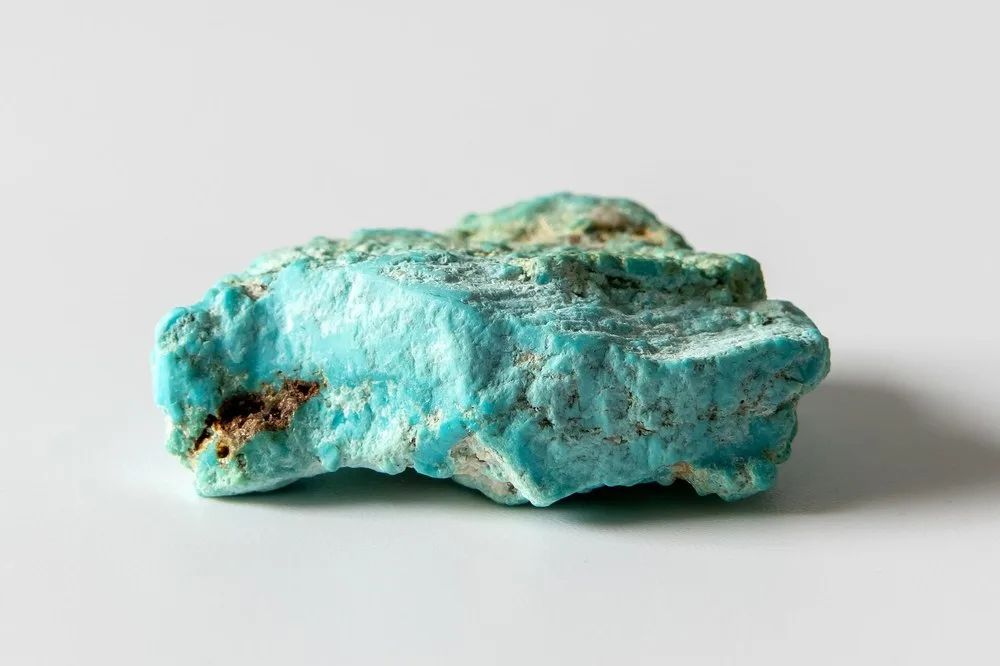
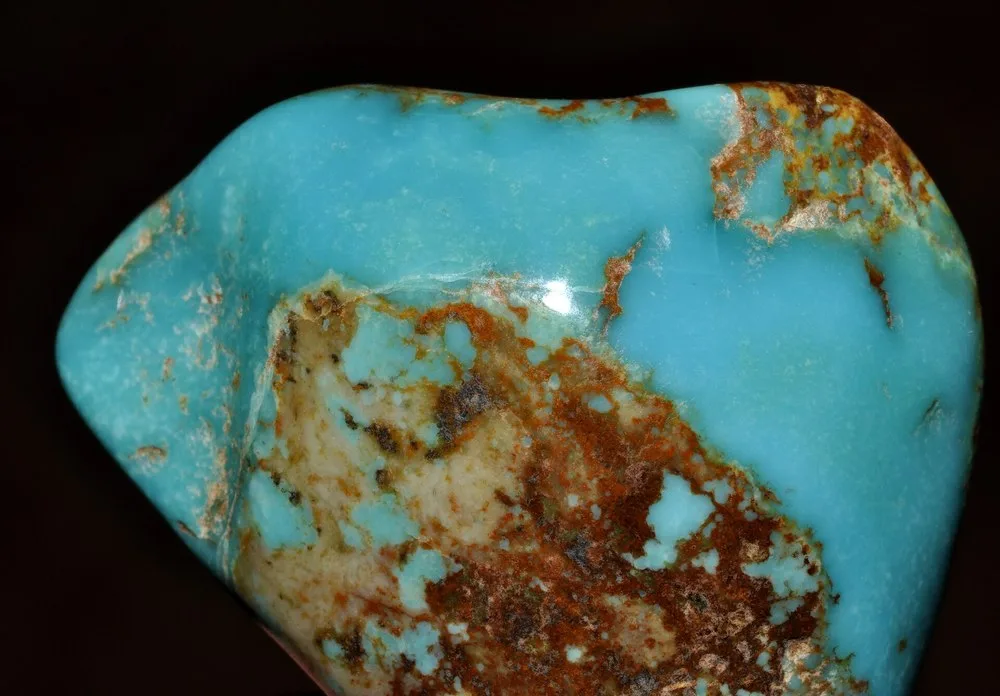
Colour – sky blue, blue, green, whiteTurquoise is a phosphate of copper and aluminium that forms only in dry desert ground. Colour follows the copper: more copper gives a deeper blue, more iron pushes it towards green. The stone is porous, so natural turquoise almost always carries "matrix" — dark lines and patches left by the host rock.
The name came through French "turqueise", the Turkish stone, because Europe first received turquoise via Turkey, though the mines themselves were in Persia, Afghanistan and Sinai. For the Egyptians it was a favourite above all others — turquoise is set into Tutankhamun's mask.
Matrix and colour set the price. Clean, even blue with no matrix costs most, and the names of old mines — Bisbee, Sleeping Beauty, Kingman — push it higher still. Stones with heavy, handsome matrix are the affordable end, and many people prefer them for the pattern alone.
Origins
Historically the best-known source is Nishapur in Iran, which has supplied the stone for more than two thousand years. Today turquoise is mined in Afghanistan, the United States (Arizona, Colorado, Nevada), Mexico, China, Tanzania, Israel, Argentina and Brazil.
Properties
Tradition treats turquoise as a protective stone: it is said to guard its owner from misfortune and the evil eye. Native American peoples made amulets from it, and in Tibet it was used medicinally for centuries.
Turquoise is believed to loosen the tongue — to help someone state their case calmly and clearly, and to cool an argument. That is why it is often recommended to people whose work is negotiation and public speaking.
Traditional healing properties
Lithotherapists connect turquoise with the throat and lungs, saying it helps with problems of the voice, the throat and breathing. In the past it was also used for eye disease and headaches.
This describes traditional practice, not medical advice. A stone does not replace a doctor.
Chakras
Turquoise is linked to the fifth, throat chakra – vishuddha. Deep blue pieces are sometimes also tied to the sixth, brow chakra – ajna.
Zodiac
Tradition gives turquoise to Sagittarius, and it is the stone of December. It also suits Pisces and Taurus, whose character matches the stone's calm clarity.
In Charcho jewellery
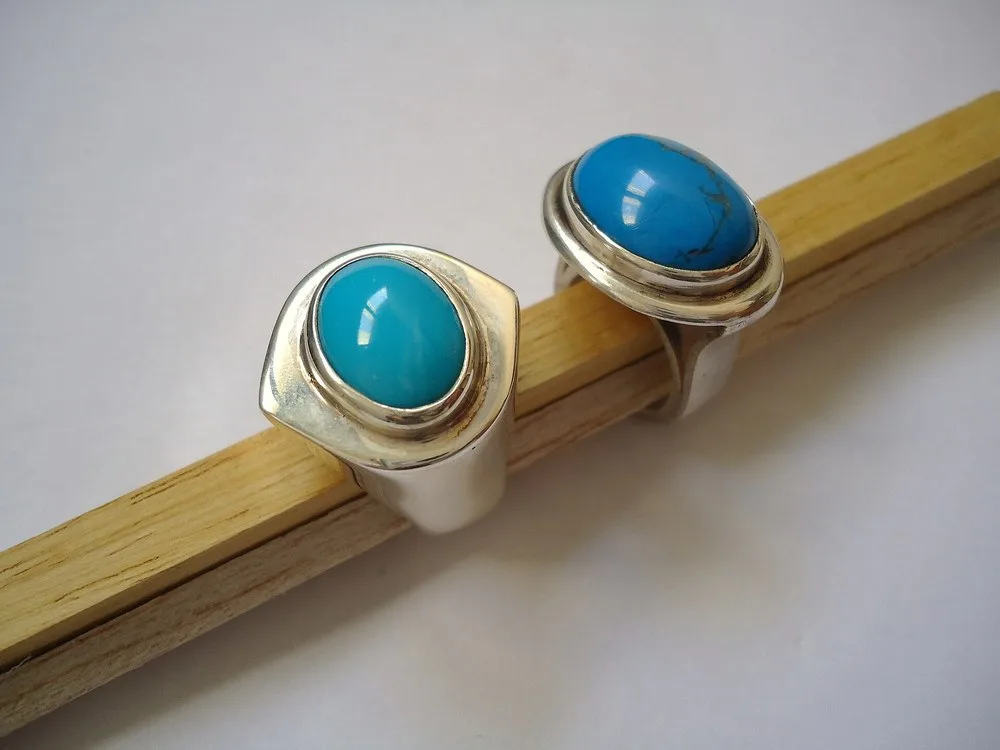
Turquoise is usually set in silver — a blue stone looks most natural beside white metal. There is no ready-made piece in the catalogue yet, but we make them to order. Catalogue: necklaces, rings.
Real or fake
- Much of the turquoise on the market is not natural. The most common substitute is dyed howlite or magnesite: both are softer, lighter, and the dye gathers in cracks.
- "Stabilised" turquoise is a real stone soaked in resin — colour and hardness are held in place artificially.
- In natural turquoise the matrix runs into the depth and repeats on the surface; in dyed material the lines sit only on top.
- A plastic imitation feels warm and light in the hand, while natural stone is cold and noticeably heavy.
Care
Hardness 5–6 plus porosity means turquoise needs care: do not soak it, do not wear it in the shower or the pool, and keep perfume, cream and soap away. A dry or barely damp soft cloth is enough. Long sun exposure fades the colour.
See also
-
Fluorite
Chemical formula – CaF₂
Hardness – 4
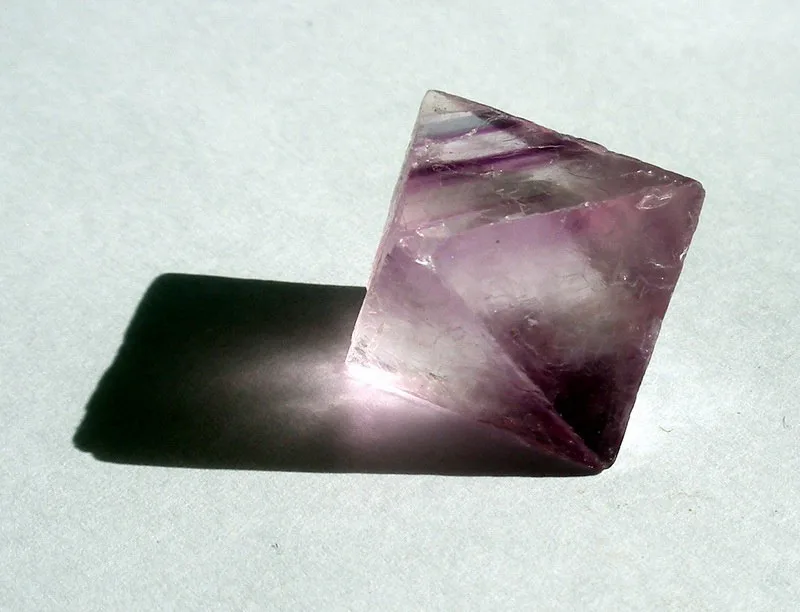
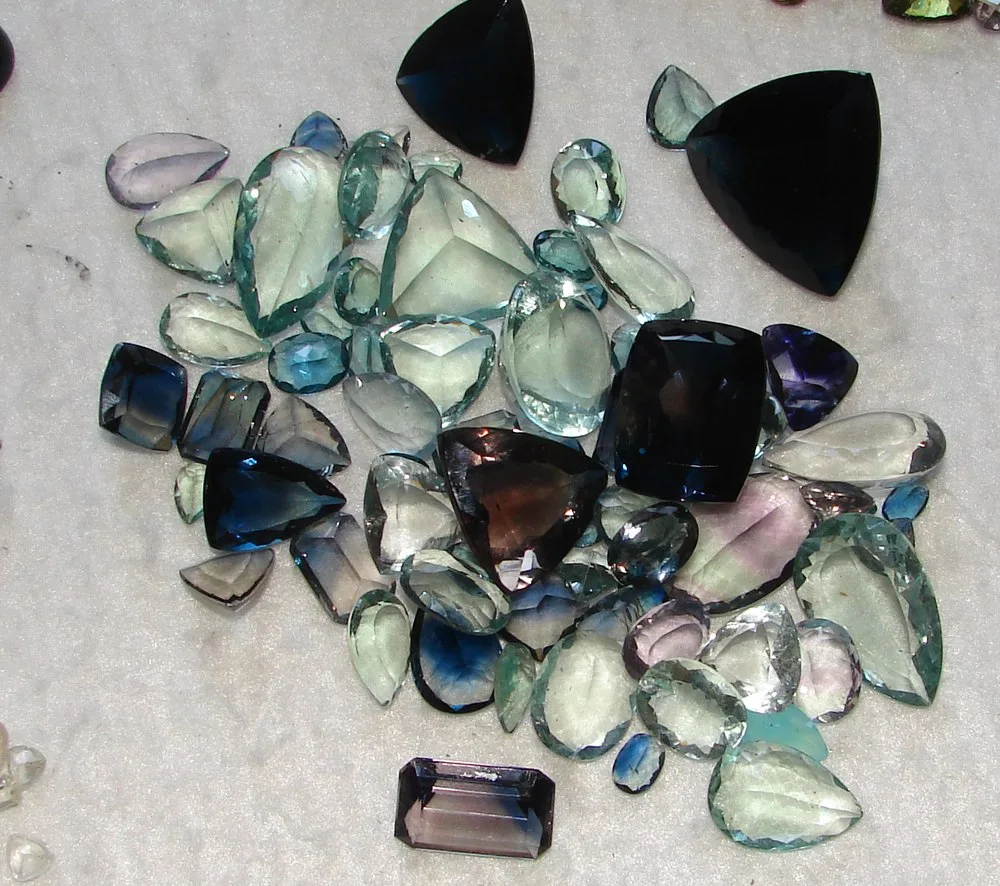
Colour – violet, blue, green, yellow, pink, colourlessFluorite is calcium fluoride and one of the most popular minerals in the world. It is called "the most colourful stone" for good reason: a single crystal shifts in bands from violet to blue to green to yellow, sometimes with rainbow transitions. It can be fully transparent, cloudy, or nearly black.
The name comes from Latin "fluere", to flow. The mineral was named for its use in metallurgy, where it was added to the melt to make it run more freely. The word "fluorescence" also comes from fluorite: some pieces glow under ultraviolet light.
Price follows depth of colour and clarity. Clear violet and blue crystals cost the most, beads and cabochons far less. The stone is soft, so in jewellery it turns up in earrings and pendants more often than in rings.
Origins
Fluorite is mined in many countries, but the best-known deposits are in Argentina, Austria, Canada, China, England, France, Germany, Mexico, Namibia, Russia and the United States. Weardale in England once produced the finest violet crystals in the world.
Properties
Esoteric writers treat fluorite as the stone of mental clarity and order. It is said to bring harmony back into life and to help a person make the right decision — especially when thoughts have become tangled.
Its second name is "the student's stone". Fluorite is believed to strengthen concentration and focus, which is why it is often recommended to anyone studying, preparing for an exam or learning a new trade.
Traditional healing properties
Lithotherapists use fluorite to steady blood pressure and to support detoxification. It is said to be good for bones and teeth, and for dizziness, coughs, pain, nervous tension, insomnia and colds.
This describes traditional practice, not medical advice. A stone does not replace a doctor.
Chakras
Green fluorite is linked to the fourth, heart chakra – anahata; violet — the sixth, brow chakra – ajna; golden — the third, solar plexus chakra – manipura; blue — the fifth, throat chakra – vishuddha.
Zodiac
Tradition gives fluorite to Capricorn, a sign that values order and system. It also suits Pisces and Aquarius, whose character sits well with the stone's intuitive side.
In Charcho jewellery
We do not have fluorite beads or cabochons in the catalogue yet, but we make them to order. For such a soft stone earrings or a pendant are the practical choice — in a ring it scratches quickly. Catalogue: earrings, necklaces.
Real or fake
- Fluorite is often replaced with glass. A natural crystal has colour zones that look different as the light direction changes; glass stays even.
- Natural fluorite has obvious cleavage planes — short, straight edges near the corners. That is its natural calling card.
- A neon colour that is too bright and too even, with a flawless surface, points either to glass or to artificial dyeing.
- An ultraviolet lamp helps: many natural fluorites glow blue or violet, though not every piece does.
Care
Hardness 4 makes fluorite one of the softest stones used in jewellery. Store it separately so other stones cannot scratch it. It needs no ultrasonic, steam or hot water, and colour fades with long exposure to sun. A soft cloth is enough.
See also
-
Tourmaline
Chemical formula – Na(Li₁.₅Al₁.₅)Al₆(Si₆O₁₈)(BO₃)₃(OH)₃(OH)
Hardness – 7–7.5
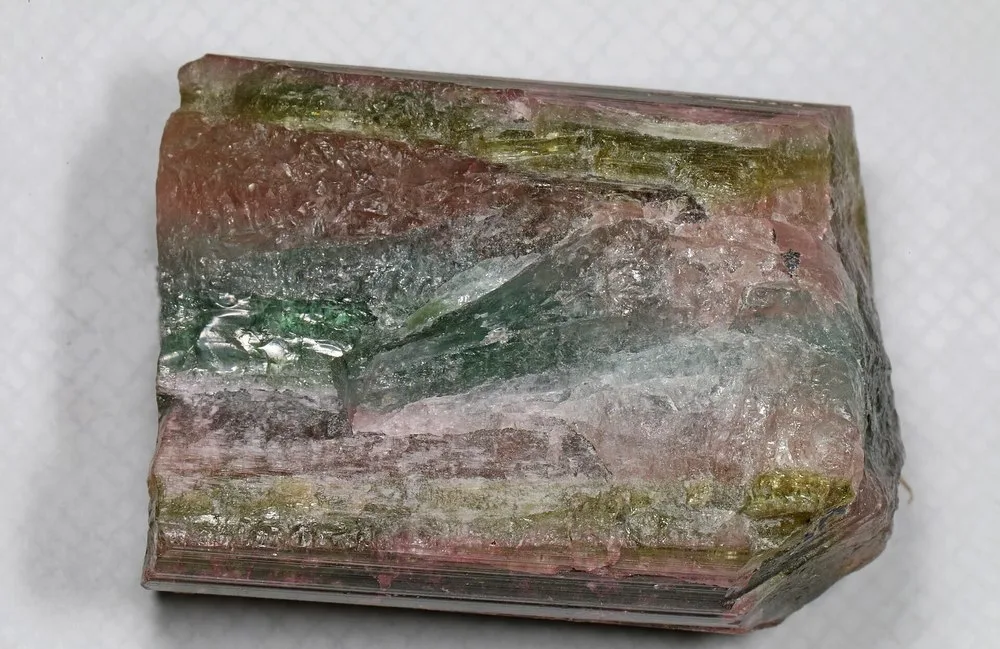
Colour – black, pink, green, yellow, blue, colourlessTourmaline is not the name of one mineral but of a whole group of complex boron silicates. Their composition shifts slightly from member to member, which is why the group covers almost every colour: inside a single crystal pink can turn into green, while neighbouring pieces come out black, yellow, blue or completely clear.
The name most likely comes from the Sinhalese "turamali", a word used in Sri Lanka for a stone of many colours. Tourmaline was in use by the 1500s but was only described properly in 1800 — before that, pink and green stones were counted as different minerals.
Varieties are sorted by colour: black schorl, red-pink rubellite, blue indicolite, the neon green-blue paraiba and the two-tone "watermelon" tourmaline. Schorl turns up in roughly 95% of deposits and stays affordable. Paraiba is so rare that its price per carat passes diamond.
Origins
Until 1900 the United States was the main supplier of tourmaline; today Brazil leads. The stone is also mined in Afghanistan, Australia, India, Madagascar, Russia, Nigeria, Pakistan, Tanzania and Nepal.
Properties
In tradition colour carries direct meaning. Black tourmaline was treated as a shamanic stone and given the role of protector in rituals — it is said to ground, to calm a panic attack and to shield against electronic radiation.
Pink tourmaline worn through the day is said to dissolve stress, irritation and fatigue. It is believed to help with insomnia and to stand beside someone healing old wounds.
Green tourmaline is counted as the stone of luck, income and success. It is said to sharpen creativity and drive, and to be especially useful when a project needs to be finished rather than started.
Traditional healing properties
Lithotherapists use pink tourmaline for headaches, nervous complaints and menopausal symptoms, green for support of the heart, and black for grounding and easing panic attacks.
This describes traditional practice, not medical advice. A stone does not replace a doctor.
Chakras
Black tourmaline is linked to the first, root chakra – muladhara; pink and green — the fourth, heart chakra – anahata; blue — the fifth, throat chakra – vishuddha.
Zodiac
Tradition ties tourmaline to Libra: it is the stone of October and matches the search for balance. It also suits Leo and Scorpio, whose character sits well with the stone's protective streak.
In Charcho jewellery
We do not have a ready-made piece in tourmaline yet, but we make them to order — you choose the colour, size and cut. Pink and green tourmaline look good in silver, while black schorl leans towards stricter everyday designs. Catalogue: necklaces, earrings.
Real or fake
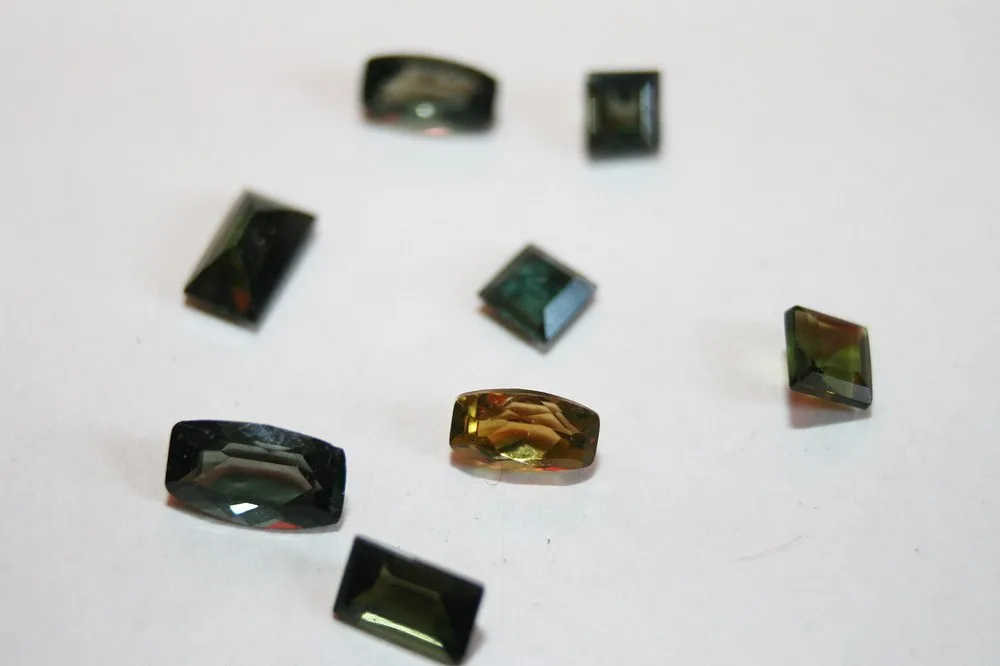
- Glass is the most common substitute. A natural stone shows a different colour from two directions, so the tone shifts as you turn the crystal; glass holds one shade.
- Cheap pink "tourmaline" is often dyed quartz: the dye collects in cracks and shows up as narrow bands.
- In "watermelon" tourmaline a pink core sits inside a green shell and the border runs in waves; in glass the line is straight and too exact.
Care
Hardness 7–7.5 takes daily wear, but pink tourmaline fades in sun and hot water — keep the piece away from the window and the radiator. Warm water, mild soap and a soft cloth are enough; skip steam and ultrasonic cleaning on a stone with cracks.
See also
-
Unakite
Chemical formula – Ca₂(Fe,Al)Al₂[O/OH/SiO₄/Si₂O₇] + K, Mg, Mn, Sr, Ti
Hardness – 6.5
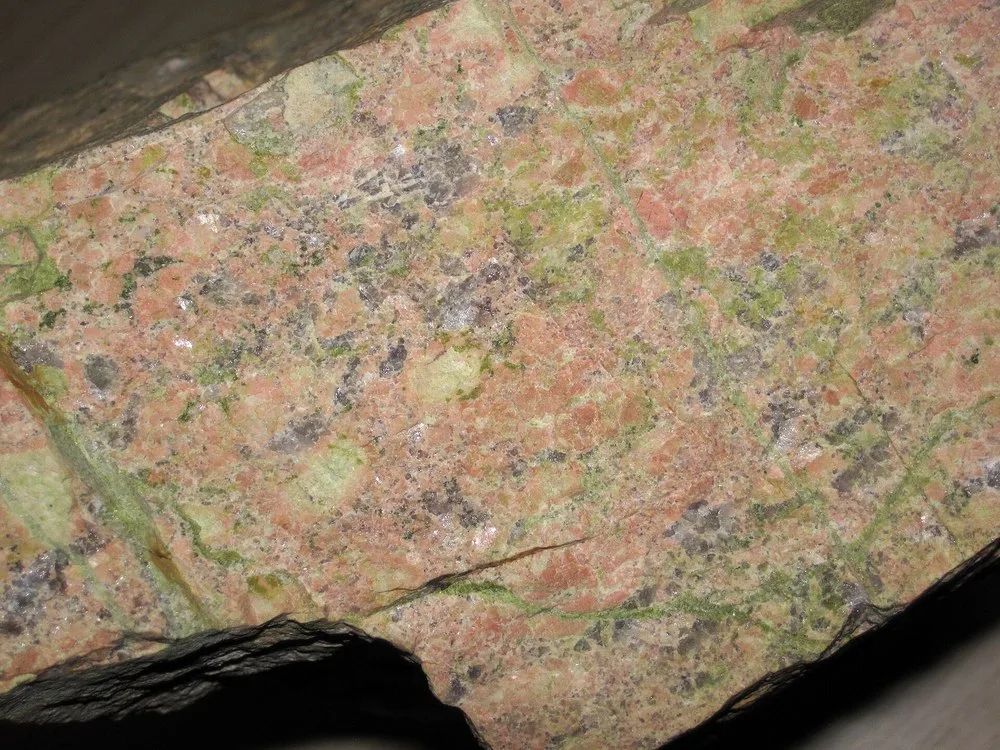
Colour – green, pink, mottledUnakite is not a pure mineral but a natural mixture of three things: green epidote, pink feldspar and quartz. That is where its unmistakable look comes from — green and pink patches in one stone, sometimes in fine speckles, sometimes in broad clouds.
The name belongs to a place. Unaka is a ridge in the Appalachians on the border of North Carolina and Tennessee, where the stone was first found. Geologically it is classed with jasper, yet unlike ordinary jasper the colour is never even: every piece carries its own pattern.
Price-wise unakite is an inexpensive stone. Value follows the pattern: the sharper and cleaner the shift from green to pink, the more the cabochon costs. Pieces where the two colours are spread almost evenly are rare and fetch the most.
Origins
Unakite is mined mainly in the United States — North Carolina, Virginia and Tennessee. Deposits also exist in Brazil, South Africa, Zimbabwe and Syria.
Properties
Unakite is regarded as a stone of healthy sleep and protection from stress. It is said to help turn goals into reality and to bring the emotional and spiritual sides of a person into order at once.
Esoteric writers say unakite returns optimism and hope to someone who has given up. In the past people believed that a stone placed under the pillow would bring a morning full of energy and joy. It is also counted as a protective stone, especially when the surroundings are unstable.
Traditional healing properties
Lithotherapists link unakite mainly with the reproductive system. It is believed to shield against radiation and to speed recovery after a serious illness.
This describes traditional practice, not medical advice. A stone does not replace a doctor.
Chakras
Unakite is linked to the fourth, heart chakra – anahata. Some sources add the third, solar plexus chakra – manipura.
Zodiac
Tradition ties unakite to Scorpio, a sign of depth and hidden processes. It also suits Cancer and Pisces, whose character matches the stone's calming nature.
In Charcho jewellery
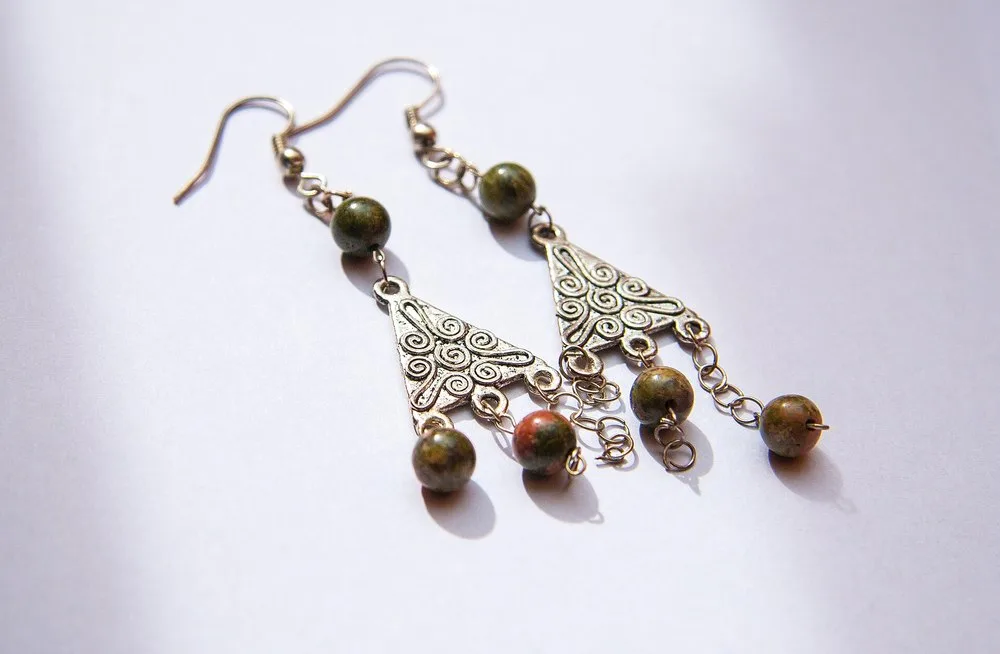
Unakite works well in beads and cabochons: its pattern keeps its character in any shape. We do not have a ready-made piece in the catalogue yet, but we make them to order — you choose the bead diameter and the cut. Catalogue: necklaces, bracelets.
Real or fake
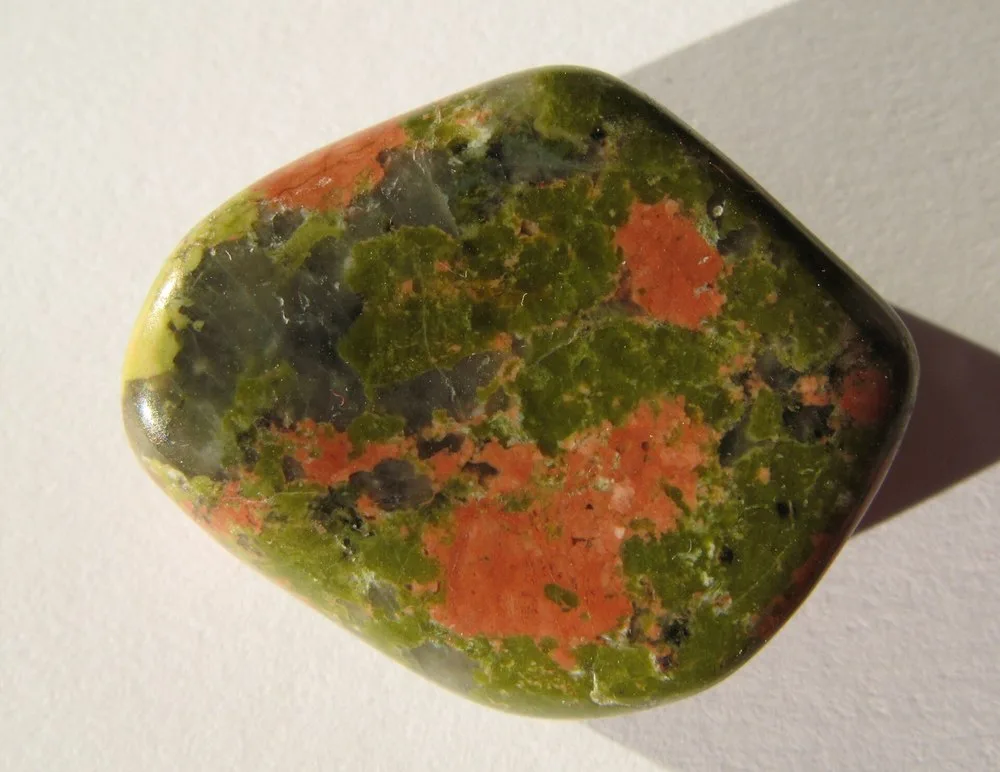
- Unakite is cheap enough that synthesising it makes no sense: fakes are usually dyed jasper or glass.
- In a natural stone green and pink give way to each other at random; in an artificial one the patches are painted on the surface and never reach the depth.
- Natural unakite carries small pores and inclusions; a perfectly smooth, plastic-looking surface should raise a question.
Care
Hardness 6.5 is middling: the stone takes daily wear but not knocks or sharp edges. Because feldspar is part of the mix, it needs no ultrasonic or steam cleaning — warm water, mild soap and a soft cloth will do. Keep acids and household chemicals away.
See also
-
Sugilite
Chemical formula – KNa₂(Fe,Mn,Al)₂Li₃Si₁₂O₃₀
Hardness – 5.5–6.5
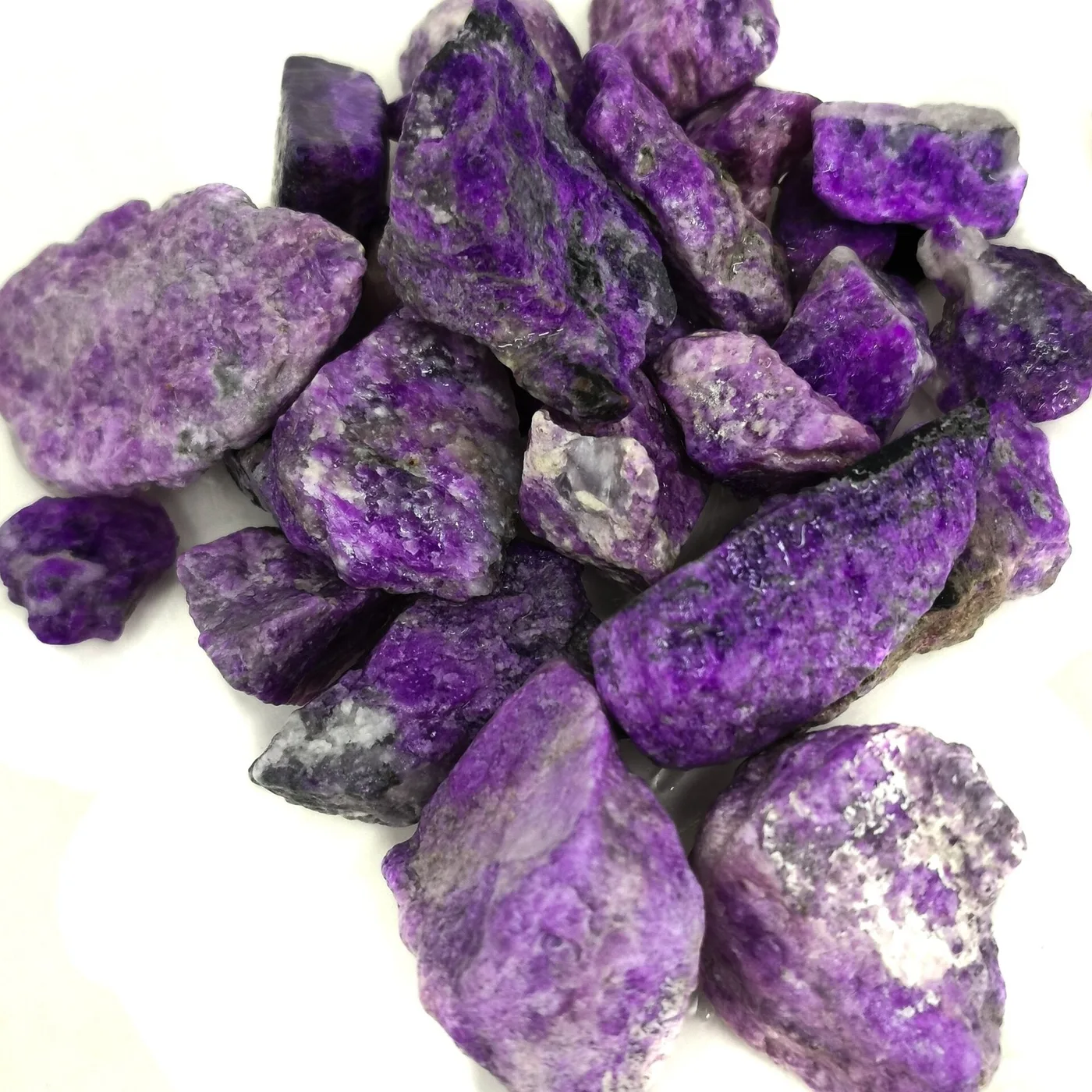
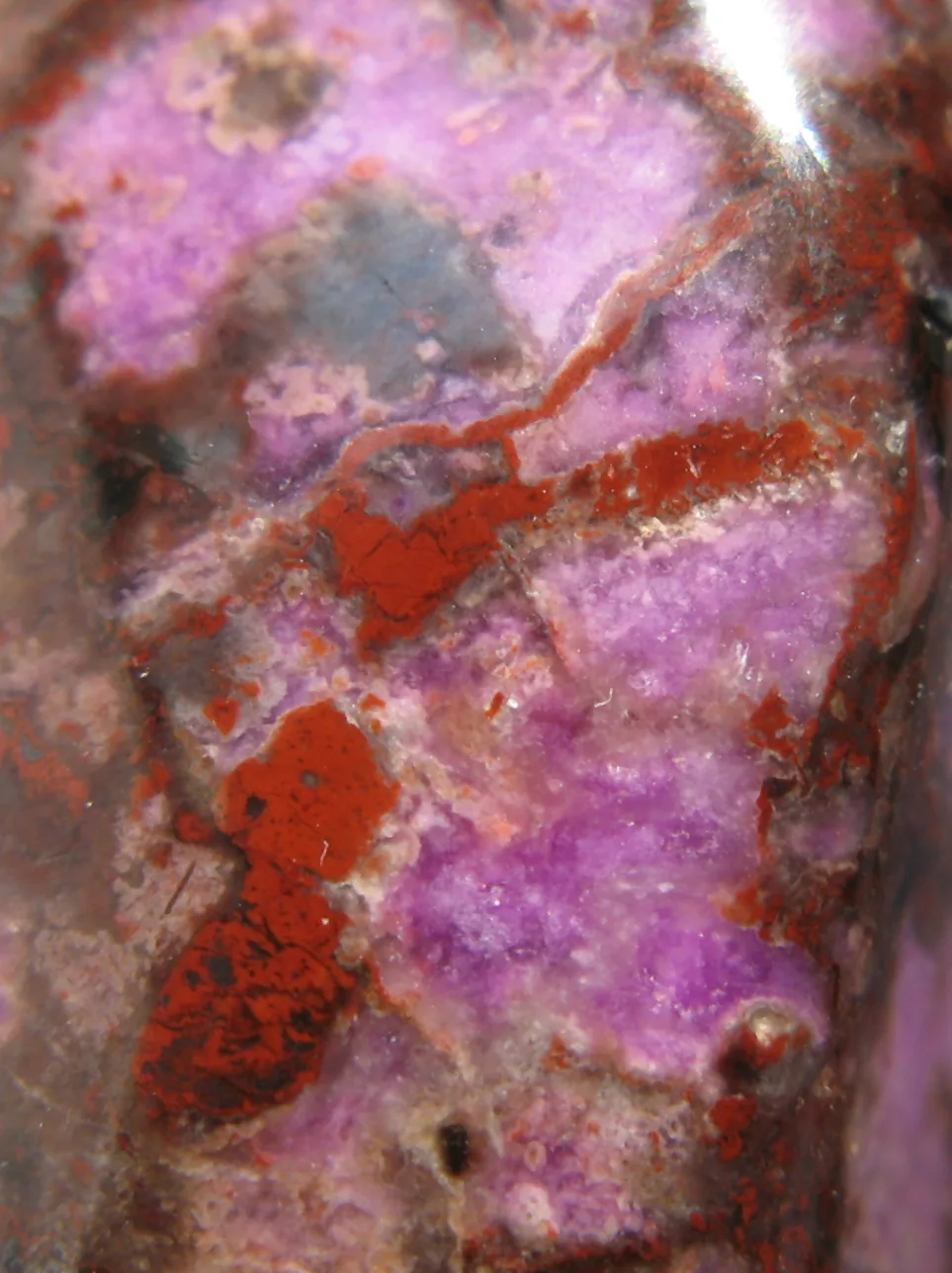
Colour – violet, lilac, pinkish violetSugilite is classed as a rare mineral, and rarity is exactly what sets its price. The colour runs from deep violet to pale lilac; a bright, saturated violet specimen is the most expensive. The hue comes from trivalent manganese — the more manganese, the deeper the colour.
The stone is named after the Japanese petrologist Ken-ichi Sugi. It was first found in 1944 on a small island in Japan, though that material was no use for jewellery.
Gem-grade sugilite today comes from essentially one place — the Kalahari manganese fields in South Africa. That is why a good violet stone is expensive, and why cheap imitations are everywhere.
Origins
Sugilite was first found in Japan. Today it is mined in South Africa, Canada, India, Australia and Italy, but in commercial volumes mainly in South Africa.
Properties
Sugilite is called the healer's stone. Esoteric writers say this violet stone helps a person carry shock and disappointment, and that it assists in uncovering hidden gifts and talents.
It is said to soften anger, jealousy and envy. More broadly, it is believed to bring calm and harmony into its owner's life.
Traditional healing properties
Lithotherapists use sugilite for headaches and chronic migraine. It is said to ease general discomfort and to help a person live more healthily.
This describes traditional practice, not medical advice. A stone does not replace a doctor.
Chakras
The sixth and seventh chakras – ajna and sahasrara.
Zodiac
Astrologers hold that sugilite works especially well for Pisces. Aquarius can wear it too — both signs are drawn to intuition and an inner life.
In Charcho jewellery
A violet stone looks best with silver and white gold. Hardness 5.5–6.5 lets us set sugilite in earrings, pendants or bracelets, and in rings with care. We have no ready-made piece in the catalogue yet. Catalogue: earrings.
Real or fake
- The commonest fake is dyed howlite or magnesite sold as "sugilite": the colour is too even, and it settles in dark lines along the cracks.
- "Sugilite jasper" is a different stone — violet patches on a jasper ground, at a much lower price.
- Real sugilite usually arrives with black and brownish patches; a perfectly uniform violet should make you suspicious.
- Price is a test in itself: sugilite is not cheap on the market, so a low price is the surest sign of a fake.
Care
Sugilite is not especially hard and it dislikes heat — warming can shift the colour. Avoid ultrasonic cleaning, steam, acids and long sun exposure. Warm water, mild soap and a soft cloth are enough; treat stabilised or dyed material with even more care.
See also

Have an idea? We will make it.
Write or call us - together we will choose the material, colour and size, and make the piece to order.